What is the Cheapest LLM API? A Guide to Affordable Models

In the rapidly evolving world of artificial intelligence, Large Language Models (LLMs) have become indispensable tools, powering everything from sophisticated chatbots and content generation platforms to advanced data analysis and complex automation workflows. As businesses and developers increasingly integrate these powerful AI capabilities into their operations and products, a critical question arises: what is the cheapest LLM API available, and how can one effectively manage and optimize these costs? The quest for affordability without sacrificing performance is a constant challenge, especially as the demand for scalable and efficient AI solutions grows.
The term "cheapest" in the context of LLM APIs is multifaceted. It's not merely about the lowest per-token price; it encompasses a broader evaluation of performance, reliability, ease of integration, and the overall total cost of ownership (TCO). A model might have an incredibly low per-token cost but deliver subpar results, requiring more iterations or human oversight, ultimately driving up operational expenses. Conversely, a slightly more expensive model that provides superior accuracy and efficiency could lead to long-term savings. This guide aims to demystify the pricing structures of various LLM APIs, highlight leading contenders for cost-effectiveness, and provide strategies for optimizing your AI budget, all while keeping an eye on the nuanced definition of "cheap."
The Evolving Landscape of Large Language Model Costs
The journey of LLMs from research curiosities to commercial powerhouses has been marked by exponential growth in capability and, initially, significant operational costs. Training these models requires immense computational resources, and running inference for millions of user queries can accumulate substantial bills. However, fierce competition among AI providers, combined with continuous innovation in model architecture and optimization techniques, has led to a welcome trend: a steady decrease in the cost of accessing powerful LLM APIs.
This competitive landscape means that what was considered expensive yesterday might be accessible today, and today's cutting-edge prices could be the baseline for tomorrow's even cheaper alternatives. For developers and businesses, this dynamic environment presents both opportunities and challenges. The opportunity lies in leveraging increasingly powerful AI at lower price points, enabling broader adoption and more innovative applications. The challenge is staying informed about the latest pricing shifts, new model releases, and best practices for cost management to ensure sustainable AI integration. Understanding the factors that drive these costs is the first step toward effective optimization.
Deconstructing LLM API Pricing: Key Factors
To truly understand what is the cheapest LLM API, we must first dissect the various components that contribute to its overall cost. LLM pricing models are not monolithic; they often involve a combination of factors that, when combined, determine your final bill.
Token-Based Billing: Input vs. Output
At the heart of most commercial LLM API pricing is the concept of "tokens." A token is a fundamental unit of text that an LLM processes. It can be a word, part of a word, or even a punctuation mark. For instance, the word "unbelievable" might be broken down into "un", "believe", and "able" by the model's tokenizer. Different models and providers use different tokenization schemes, meaning the same text might result in a different token count across various APIs.
Crucially, most providers differentiate between:
- Input Tokens: These are the tokens in your prompt, including any system messages, user queries, few-shot examples, and conversational history you send to the model.
- Output Tokens: These are the tokens in the response generated by the LLM.
Typically, output tokens are more expensive than input tokens. This is because generating text is generally more computationally intensive than simply processing an existing prompt. The difference in price can be substantial, often 2x to 5x higher for output. This distinction is vital for cost optimization; developers should strive to make prompts concise and instruct the model to provide equally concise, yet comprehensive, responses.
The context window is another critical aspect related to tokens. This refers to the maximum number of tokens (both input and output combined) that an LLM can consider at any given time. Larger context windows allow models to process more information, maintain longer conversations, or analyze more extensive documents, but they also mean that each query, even if it has a short new prompt, can incur costs for all the "history" tokens in the context. While larger context windows offer powerful capabilities, they can also quickly inflate costs if not managed carefully.
Model Architecture and Performance
The underlying architecture and size of an LLM significantly impact its cost. Generally:
- Smaller, Faster Models: These models have fewer parameters, are quicker to run, and are less expensive per token. They are ideal for simpler tasks like basic summarization, classification, or rapid prototyping where extreme accuracy or complex reasoning isn't required.
- Larger, More Capable Models: These models, often featuring billions or even trillions of parameters, are designed for complex reasoning, highly creative tasks, and applications demanding the highest accuracy. While their per-token price is higher, their superior performance can sometimes lead to lower overall costs by reducing the need for multiple attempts or extensive post-processing.
The trade-off is clear: you pay for capability. A highly sophisticated model like GPT-4o will inherently be more expensive per token than a smaller, faster alternative like gpt-4o mini or Claude 3 Haiku. The key is to match the model's capability to the task's requirements. Over-engineering with an overly powerful model for a simple task is a common source of unnecessary expense.
Provider Strategies and Market Dynamics
The LLM market is highly competitive, with major players like OpenAI, Anthropic, Google, and Mistral AI constantly innovating and adjusting their pricing strategies. This competition is a boon for consumers, driving prices down and encouraging the release of more specialized, cost-effective models.
- Tiered Pricing: Many providers offer different pricing tiers based on usage volume, committing to long-term contracts, or accessing advanced features.
- Specialized Models: Providers are increasingly releasing "mini" or "flash" versions of their flagship models, specifically designed for speed and cost-efficiency while retaining a good level of performance for common tasks. This is where models like gpt-4o mini and Claude 3 Haiku shine.
- Open-Source vs. Commercial APIs: Open-source models (like Meta's Llama series or Mistral 7B) can appear "free" on the surface, but they incur infrastructure costs for hosting, inference, and potentially maintenance. Commercial APIs, while having a per-token fee, abstract away these infrastructure complexities, offering a simpler, managed solution. The "cheapest" option depends heavily on your team's expertise and existing infrastructure.
Latency, Throughput, and Rate Limits
While not directly tied to per-token pricing, operational factors like latency, throughput, and rate limits can indirectly affect the total cost of ownership:
- Latency: The time it takes for the API to respond. High latency can degrade user experience in real-time applications (e.g., chatbots), potentially leading to user churn or the need for more complex workarounds.
- Throughput: The number of requests an API can handle per unit of time. Low throughput can become a bottleneck for high-volume applications, requiring more elaborate queueing systems or potentially impacting revenue.
- Rate Limits: The maximum number of requests or tokens you can send within a specific timeframe. Exceeding these limits can lead to rejected requests, necessitating retries or more robust error handling, which consumes developer time and can delay operations.
While these don't appear on a token price sheet, they impact the efficiency and reliability of your application, and thus your operational costs and user satisfaction. A cheaper API with severe rate limits might end up costing more in terms of developer hours and lost opportunities.
Leading Contenders for the Cheapest LLM API
Now, let's delve into some of the top contenders when asking what is the cheapest LLM API, focusing on models that strike an excellent balance between cost-effectiveness and performance.
OpenAI's Strategic Shift: Introducing gpt-4o mini
OpenAI has consistently been a frontrunner in LLM innovation, and its recent release of gpt-4o mini represents a significant strategic move towards making advanced AI more accessible and affordable. Designed as a lighter, faster version of its flagship GPT-4o, gpt-4o mini aims to deliver GPT-4 level intelligence at a fraction of the cost, positioning it as a strong candidate for developers seeking an economically viable yet highly capable model.
- Pricing: gpt-4o mini typically offers significantly lower per-token pricing compared to GPT-4 Turbo or even older GPT-3.5 Turbo models, especially for output tokens. This makes it incredibly attractive for high-volume applications where cost efficiency is paramount. For example, its input token price is often 1/20th of GPT-4 Turbo, and its output price is 1/10th.
- Performance: Despite its "mini" designation, gpt-4o mini is surprisingly powerful. It excels at a wide range of common tasks including summarization, text generation, translation, coding assistance, and content creation. Its performance often rivals or surpasses that of many older, more expensive models, making it a compelling choice for many general-purpose applications. It's built on the same "omni-model" architecture as GPT-4o, meaning it can process text and images, offering multimodal capabilities at a very low price point.
- Ideal Use Cases: Customer support chatbots, large-scale content summarization, automated email responses, basic code generation and review, data extraction from documents, and simple language translation tasks are all areas where gpt-4o mini can shine without breaking the bank. Its speed and cost-effectiveness make it suitable for real-time applications and scenarios requiring rapid iteration.
- Accessibility and Integration: As part of the OpenAI ecosystem, gpt-4o mini benefits from extensive documentation, a robust API, and a large developer community, making integration straightforward for those already familiar with OpenAI's offerings.
Anthropic's Claude 3 Haiku: A Strong Challenger
Anthropic's Claude series has gained significant traction for its strong performance and safety-focused design. With the introduction of the Claude 3 family, Anthropic also joined the race for affordability with Claude 3 Haiku, explicitly designed for speed and cost-efficiency.
- Pricing: Claude 3 Haiku boasts some of the lowest per-token prices in the industry, making it highly competitive, particularly for tasks requiring fast responses and large volumes of processing. Its input and output token prices are often among the lowest for models of its caliber.
- Performance: Haiku is optimized for speed and efficiency, making it incredibly fast. It performs admirably on tasks such as quick summarization, data extraction, content moderation, and simple Q&A. While not as capable as its larger siblings (Sonnet or Opus) for complex reasoning or highly creative tasks, it delivers excellent performance within its intended scope.
- Ideal Use Cases: Real-time chat applications, swift content filtering, sentiment analysis, basic data classification, and other high-throughput, low-latency requirements are where Haiku truly excels.
- Context Window: Claude 3 models, including Haiku, offer a very large context window (up to 200K tokens), which can be advantageous for processing lengthy documents or maintaining extended conversational memory, provided the associated costs are managed.
Google's Gemini Flash and Gemma Series
Google, with its vast AI research and infrastructure, offers its own compelling options for cost-effective LLMs.
- Gemini Flash: Part of the Gemini family, Gemini Flash is Google's answer to the need for a fast, efficient, and affordable model. It's optimized for high-volume, low-latency applications, making it suitable for similar use cases as gpt-4o mini and Claude 3 Haiku. Its multimodal capabilities (text, image, video understanding) at an affordable price point give it a distinct edge for certain applications.
- Gemma Series: Gemma is a family of lightweight, open-source models built by Google DeepMind. While not an "API" in the traditional sense (you need to host it yourself), Gemma 2B and 7B models offer incredible potential for cost savings if you have the infrastructure and expertise to deploy them. The cost here shifts from per-token fees to infrastructure, compute, and maintenance. This can be significantly cheaper for very high-volume, specialized applications if effectively managed.
- Google's Ecosystem: For users already embedded in the Google Cloud ecosystem, integrating Gemini Flash or deploying Gemma via Vertex AI can offer additional benefits in terms of unified billing, security, and developer tools.
Mistral AI: Open-Source Roots, Commercial Offerings
Mistral AI, a European challenger, has quickly gained recognition for developing highly efficient and powerful models, often with an open-source ethos.
- Mistral 7B and Mixtral 8x7B: These models are often cited for their impressive performance given their relatively small size. While available open-source for self-hosting (again, shifting cost to infrastructure), Mistral also offers managed API access through platforms like Azure AI, AWS Bedrock, or directly through their own API. When accessed via API, their pricing is very competitive, especially for the excellent quality they deliver. Mixtral, a sparse mixture-of-experts model, provides excellent performance for its inference cost.
- Mistral Large: While Mistral Large is a premium model designed for top-tier performance, Mistral's other offerings remain strong contenders for cost-efficiency. Their focus on efficiency means that even their larger models are often more resource-friendly than comparable models from other providers.
- Efficiency Focus: Mistral's models are known for their strong performance-to-cost ratio, often delivering high-quality outputs with fewer parameters, leading to faster inference and lower operational costs.
Meta Llama 3: The Power of Open-Source
Meta's Llama series, particularly Llama 3 (8B and 70B parameters), stands as a beacon for the open-source community. While Llama 3 itself is free to download and use, the "cost" comes in the form of deployment and inference.
- Self-Hosting Costs: Deploying Llama 3 requires significant GPU resources. This means purchasing or renting GPUs (e.g., via AWS, Google Cloud, Azure, or specialized GPU providers like Lambda Labs or CoreWeave), managing infrastructure, and handling scaling. For large-scale operations, these costs can quickly add up, but for niche applications or those with existing compute infrastructure, it can be extremely cost-effective.
- Managed Services: Many providers offer Llama 3 as a managed service through their APIs (e.g., AWS Bedrock, Azure AI, Anyscale, Groq, Perplexity AI). These platforms abstract away the infrastructure complexity, charging a per-token fee. Often, these managed services offer very competitive pricing for Llama 3, making it a viable "API" option. For example, platforms like Groq are famous for extremely fast inference speeds for Llama 3, potentially lowering the total cost for latency-sensitive applications.
- Flexibility: The open-source nature of Llama 3 offers unparalleled flexibility for fine-tuning and customization, which can lead to highly optimized and cost-efficient specialized models over time.
Token Price Comparison: A Detailed Analysis
Understanding the nuances of each model is crucial, but a direct Token Price Comparison provides a clear snapshot of the immediate financial outlay. It’s important to remember that these prices are subject to change and may vary slightly based on volume discounts, region, and specific API versions. The following table provides a general overview of competitive models often cited when discussing what is the cheapest LLM API.
TABLE: LLM API Token Price Comparison (Approximate, per 1 Million Tokens, as of Mid-2024)
| Model | Provider | Input Price (per 1M tokens) | Output Price (per 1M tokens) | Context Window (tokens) | Key Features / Notes |
|---|---|---|---|---|---|
| GPT-4o mini | OpenAI | \$0.15 | \$0.60 | 128K | Highly cost-effective multimodal model, excellent balance of performance and price for general tasks. Successor to GPT-3.5 Turbo for many use cases. |
| Claude 3 Haiku | Anthropic | \$0.25 | \$1.25 | 200K | Extremely fast and efficient for high-volume, low-latency applications. Good for summarization, chat, data extraction. Focus on safety. |
| Gemini 1.5 Flash | \$0.35 | \$0.35 | 1M | Google's fast, multimodal option with a massive 1M token context window. Very competitive output pricing. | |
| Mistral 7B (API) | Mistral AI | \$0.15 | \$0.45 | 32K | Very strong performance for a small model. Ideal for simple tasks and embedding. API access often via third-party providers or Mistral's platform. |
| Mixtral 8x7B (API) | Mistral AI | \$0.25 | \$0.75 | 32K | Mixture-of-Experts model, offering excellent performance for its cost. Good for complex reasoning without the higher price tag of larger models. |
| Llama 3 8B (via Groq) | Groq (Managed) | \$0.07 | \$0.07 | 8K | Extremely low latency and competitive pricing via Groq's LPU inference engine. Ideal for real-time applications where speed is paramount. Lower context window. |
| Llama 3 70B (via Groq) | Groq (Managed) | \$0.70 | \$0.70 | 8K | Fast inference for a larger model via Groq. Very competitive pricing for its capability, but similar context window limitation as 8B. |
| Command R+ | Cohere | \$3.00 | \$15.00 | 128K | High-quality model with RAG capabilities built-in. More expensive but excellent for enterprise search and specific business applications. |
| GPT-3.5 Turbo | OpenAI | \$0.50 | \$1.50 | 16K | A workhorse, but often superseded by gpt-4o mini in terms of price/performance for many tasks. Still a solid, reliable option. |
| GPT-4 Turbo | OpenAI | \$10.00 | \$30.00 | 128K | High-end general-purpose model, significantly more expensive but offers top-tier reasoning and creativity. Used when accuracy and complexity are paramount. |
Note: Prices are illustrative and subject to change. Always check the official provider documentation for the most current pricing. Prices often decrease with higher usage tiers or specific commitments. Some prices are for general text models, others are multimodal, which may affect direct comparison depending on use case.
Interpreting the Data: When Raw Token Price Isn't the Only Metric
Looking at this Token Price Comparison table, it's clear that models like gpt-4o mini, Claude 3 Haiku, Gemini Flash, and Llama 3 (especially via optimized inference providers like Groq) stand out for their aggressive pricing. However, a model with the absolute lowest per-token price isn't always the most cost-effective solution overall.
Consider the following:
- Quality per Dollar: A model like gpt-4o mini might have a slightly higher token price than a Llama 3 8B model on Groq, but if it consistently provides more accurate and relevant responses for your specific task, it could reduce the need for manual review, retries, or post-processing, thus saving more money in the long run.
- Context Window: Models with larger context windows (like Gemini 1.5 Flash or Claude 3 Haiku) might seem more expensive initially, but if your application requires processing very long documents or maintaining extensive conversation history, they could be cheaper than having to chunk text and manage state manually with models that have smaller context windows.
- Speed (Latency): For real-time applications like live chatbots, models optimized for low latency (like Groq's Llama 3 inference or Gemini Flash) can offer a superior user experience. A slower "cheaper" model might lead to user frustration or timeouts, indirectly impacting your business.
- Multimodality: If your application needs to process images alongside text, a multimodal model like gpt-4o mini or Gemini 1.5 Flash, even if slightly pricier than a text-only alternative, might offer a more streamlined and ultimately cheaper solution than integrating separate image analysis APIs.
The ideal "cheapest LLM API" is therefore the one that provides the best balance of cost, performance, and suitability for your specific application's requirements.
XRoute is a cutting-edge unified API platform designed to streamline access to large language models (LLMs) for developers, businesses, and AI enthusiasts. By providing a single, OpenAI-compatible endpoint, XRoute.AI simplifies the integration of over 60 AI models from more than 20 active providers(including OpenAI, Anthropic, Mistral, Llama2, Google Gemini, and more), enabling seamless development of AI-driven applications, chatbots, and automated workflows.
Beyond Raw Price: Total Cost of Ownership and Performance per Dollar
Optimizing LLM costs involves looking beyond the headline token price. A comprehensive view considers the Total Cost of Ownership (TCO) and the concept of "performance per dollar."
Quality and Accuracy Trade-offs
The cheapest API isn't a bargain if it consistently generates irrelevant, inaccurate, or "hallucinated" responses. The hidden costs of poor quality include:
- Manual Intervention: If your LLM-powered application frequently requires human review, editing, or correction, the cost of human labor can quickly eclipse any savings from a low-cost API.
- Reduced User Satisfaction: In customer-facing applications, poor LLM responses can lead to user frustration, decreased engagement, and ultimately, churn. This has direct revenue implications.
- Increased Iterations: If a model frequently fails to understand prompts or requires multiple attempts to get a usable output, you're paying for multiple API calls, thereby eroding per-token savings.
Sometimes, investing in a slightly more expensive but significantly more capable model, such as GPT-4o or Claude 3 Sonnet, can lead to substantial savings by reducing these downstream costs. The goal is to find the model that provides the "good enough" quality for your specific task at the lowest possible price point.
Latency and Throughput for Real-Time Applications
For applications requiring real-time interaction (e.g., live chat, voice assistants, instant content generation), latency and throughput are crucial.
- Latency Impact: A slower API, even if cheaper per token, can degrade user experience. For example, a chatbot taking several seconds to respond can frustrate users and lead to them abandoning the interaction. This negatively impacts user engagement and satisfaction, potentially leading to lost business. In scenarios like live coding assistance, high latency can break the developer's flow.
- Throughput Bottlenecks: If your application experiences high traffic, an API with low throughput or strict rate limits can become a bottleneck. You might need to implement complex queuing systems, retry logic, or even scale out your own infrastructure to compensate, all of which add cost and complexity. A slightly more expensive API that can handle significantly higher query volumes per second might be more cost-effective in the long run by ensuring smooth operation and reducing the need for elaborate backend systems. Providers like Groq, with their specialized LPU inference engine, exemplify how focusing on speed can lead to a compelling cost-performance ratio, even if the raw token price isn't always the absolute lowest for every single model.
Developer Experience and Ecosystem
The ease with which you can integrate, manage, and monitor an LLM API also contributes to its TCO.
- API Simplicity and Documentation: A well-designed API with clear, comprehensive documentation and SDKs (Software Development Kits) reduces developer onboarding time and ongoing maintenance efforts. Conversely, a poorly documented API can lead to countless hours of debugging and custom integration work.
- Community Support: A large and active developer community can provide invaluable resources, tutorials, and troubleshooting assistance, saving your team time and effort.
- Monitoring and Analytics Tools: Robust tools for tracking API usage, costs, and performance can help identify areas for optimization and prevent unexpected billing surprises.
- Unified Platforms: Managing multiple LLM APIs, each with its own authentication, rate limits, and data formats, can be a significant operational overhead. Unified API platforms are emerging to address this challenge, offering a single point of integration for various models.
Advanced Strategies for LLM Cost Optimization
Beyond simply picking the "cheapest" model, active strategies can significantly reduce your LLM expenses while maintaining or even improving performance.
Smart Model Selection for Specific Tasks
One of the most powerful optimization techniques is to avoid using a sledgehammer for a nut. Different LLMs excel at different tasks and come with different price tags.
- Tiered Model Usage: Implement a system where requests are routed to the most appropriate model based on complexity. For instance:
- Tier 1 (Cheapest): Use a model like gpt-4o mini, Claude 3 Haiku, or Llama 3 8B for simple tasks like basic summarization, sentiment analysis, or initial content filtering.
- Tier 2 (Mid-range): If the initial model can't handle the query, or for moderately complex tasks like detailed information extraction or more nuanced content generation, route to a model like Mixtral 8x7B or GPT-3.5 Turbo.
- Tier 3 (Premium): Reserve the most powerful and expensive models (e.g., GPT-4o, Claude 3 Opus) for truly complex reasoning, highly creative tasks, or critical applications where accuracy is paramount and cost is a secondary concern.
- Specialized Models: For highly specific tasks (e.g., medical transcription, legal document analysis), consider fine-tuning a smaller, open-source model or using a specialized API if available.
Prompt Engineering for Efficiency
The way you construct your prompts can have a dramatic effect on both the quality of the output and the number of tokens consumed.
- Be Concise and Clear: Eliminate unnecessary words from your prompts. Get straight to the point with clear instructions.
- Specify Output Format: Instruct the model to generate responses in a specific, minimal format (e.g., JSON, bullet points) to reduce extraneous tokens.
- Use Few-Shot Examples Wisely: While few-shot examples improve performance, they also add to input token count. Use just enough examples to guide the model, not an excessive amount.
- Summarize Context: For long conversations or documents, don't send the entire history or document with every query. Instead, summarize previous turns or use techniques like RAG (Retrieval Augmented Generation) to retrieve only the most relevant chunks of information.
- Batch Requests: If you have multiple independent prompts (e.g., summarizing several short articles), send them in a single batch API call if the provider supports it. This can reduce overhead and improve throughput, potentially leading to lower effective costs.
Caching and Response Deduplication
For applications that frequently encounter repetitive queries, caching can be a game-changer for cost savings.
- Implement a Cache Layer: Before sending a request to the LLM API, check if a similar query has been processed recently and if its response is stored in your cache. If a valid cached response exists, return it directly without incurring API costs.
- Hash Input Prompts: Use hashing or similarity algorithms to identify duplicate or near-duplicate prompts.
- Consider Cache Invalidation: Establish clear rules for when cached responses become stale and need to be re-generated by the LLM (e.g., time-based, content-change detection).
- Use Cases: Caching is particularly effective for generating static content, FAQs, or processing common customer service inquiries where responses are largely consistent.
Fine-tuning vs. Prompt Engineering: A Cost Perspective
Deciding whether to fine-tune a smaller model or rely solely on prompt engineering with a larger, general-purpose model is a strategic cost decision.
- Fine-tuning: Involves training a pre-trained LLM on your specific dataset to adapt its behavior to your domain or task.
- Initial Cost: Fine-tuning incurs upfront costs for data preparation, compute resources for training, and potentially expert labor.
- Long-Term Savings: A fine-tuned smaller model can often achieve the performance of a much larger, general-purpose model for a specific task. Once fine-tuned, its inference costs per token will typically be significantly lower than the larger model's, leading to substantial savings over time, especially for high-volume, specialized applications. It also reduces prompt length as the model inherently understands your domain.
- Prompt Engineering: Relies on crafting sophisticated prompts to guide a general-purpose LLM to perform a task.
- Low Initial Cost: No training required, just API calls.
- Higher Ongoing Inference Costs: May require longer, more complex prompts (more input tokens) and using more expensive, larger models to achieve desired quality.
For highly specialized or critical tasks with high usage, the initial investment in fine-tuning can yield a much lower TCO than continuously paying for a powerful general-purpose LLM.
Leveraging Unified API Platforms for Optimal Cost and Performance
Navigating the multitude of LLM providers, their various models, and their constantly changing pricing structures can be incredibly complex. Each API often has different authentication methods, data formats, rate limits, and error handling mechanisms. This complexity makes it challenging to implement smart routing strategies, compare costs effectively, or switch models seamlessly.
For developers and businesses navigating this complex landscape, platforms like XRoute.AI offer a revolutionary solution. XRoute.AI is a cutting-edge unified API platform designed to streamline access to large language models (LLMs) for developers, businesses, and AI enthusiasts. By providing a single, OpenAI-compatible endpoint, XRoute.AI simplifies the integration of over 60 AI models from more than 20 active providers, enabling seamless development of AI-driven applications, chatbots, and automated workflows.
Here's how XRoute.AI directly addresses the challenges of finding and utilizing the cheapest LLM API and optimizing costs:
- Single Integration Point: Instead of integrating with individual APIs from OpenAI, Anthropic, Google, Mistral, etc., you integrate once with XRoute.AI. This significantly reduces developer time and effort, cutting down on the "developer experience" aspect of TCO.
- Cost-Effective AI through Dynamic Routing: XRoute.AI's intelligent routing capabilities can automatically direct your requests to the most cost-effective model for a given task, or the one that meets specific performance criteria (e.g., lowest latency). This means you always get the best price-to-performance ratio without manually managing which API to call. It simplifies the process of finding what is the cheapest LLM API for your real-time needs.
- Access to a Vast Ecosystem: With access to over 60 models from more than 20 providers, XRoute.AI offers unparalleled flexibility. You can experiment with different models, switch providers, or leverage specialized models without re-coding your application. This breadth of choice is critical for finding the "just right" model that offers optimal performance at the lowest cost.
- Low Latency AI and High Throughput: The platform is engineered for high performance, ensuring low latency AI responses and high throughput. This is crucial for real-time applications where speed is paramount and can significantly reduce the operational costs associated with slow responses or API bottlenecks.
- Scalability and Flexible Pricing: XRoute.AI is built for scalability, capable of handling projects of all sizes, from startups to enterprise-level applications. Its flexible pricing model is designed to be cost-effective AI, allowing you to optimize spending as your usage grows and shifts across different models and providers.
- OpenAI-Compatible Endpoint: The OpenAI-compatible endpoint makes it incredibly easy for developers already familiar with the OpenAI API structure to switch over and immediately benefit from the broader range of models and optimization features offered by XRoute.AI.
In essence, XRoute.AI acts as an intelligent intermediary that not only simplifies LLM access but also actively helps users minimize their spending by automating model selection and routing based on cost and performance metrics. It allows developers to focus on building innovative applications rather than getting bogged down in the complexities of LLM API management and cost optimization.
The Future of Affordable LLMs
The trend towards more affordable and efficient LLMs is expected to continue. We can anticipate:
- Continued Price Competition: As more players enter the market and existing ones refine their models, prices will likely continue to trend downwards, especially for general-purpose tasks.
- Emergence of Highly Specialized Models: We'll see more models optimized for very specific tasks (e.g., medical coding, legal summarization) that offer high accuracy at a lower inference cost for their niche.
- Further Hardware Innovations: Advances in AI chips (like GPUs, TPUs, and specialized LPUs like Groq's) and inference optimization techniques will make running LLMs even faster and cheaper.
- Increased Focus on Open-Source Ecosystem: Open-source models will continue to improve, providing powerful "free" alternatives that, when combined with cost-effective hosting solutions, can significantly reduce API dependency.
- Sophisticated Orchestration Layers: Platforms like XRoute.AI will become even more intelligent, offering advanced features for dynamic model routing, fine-tuning management, and real-time cost monitoring across a diverse portfolio of LLMs.
Conclusion: Navigating the Cost-Efficiency Labyrinth
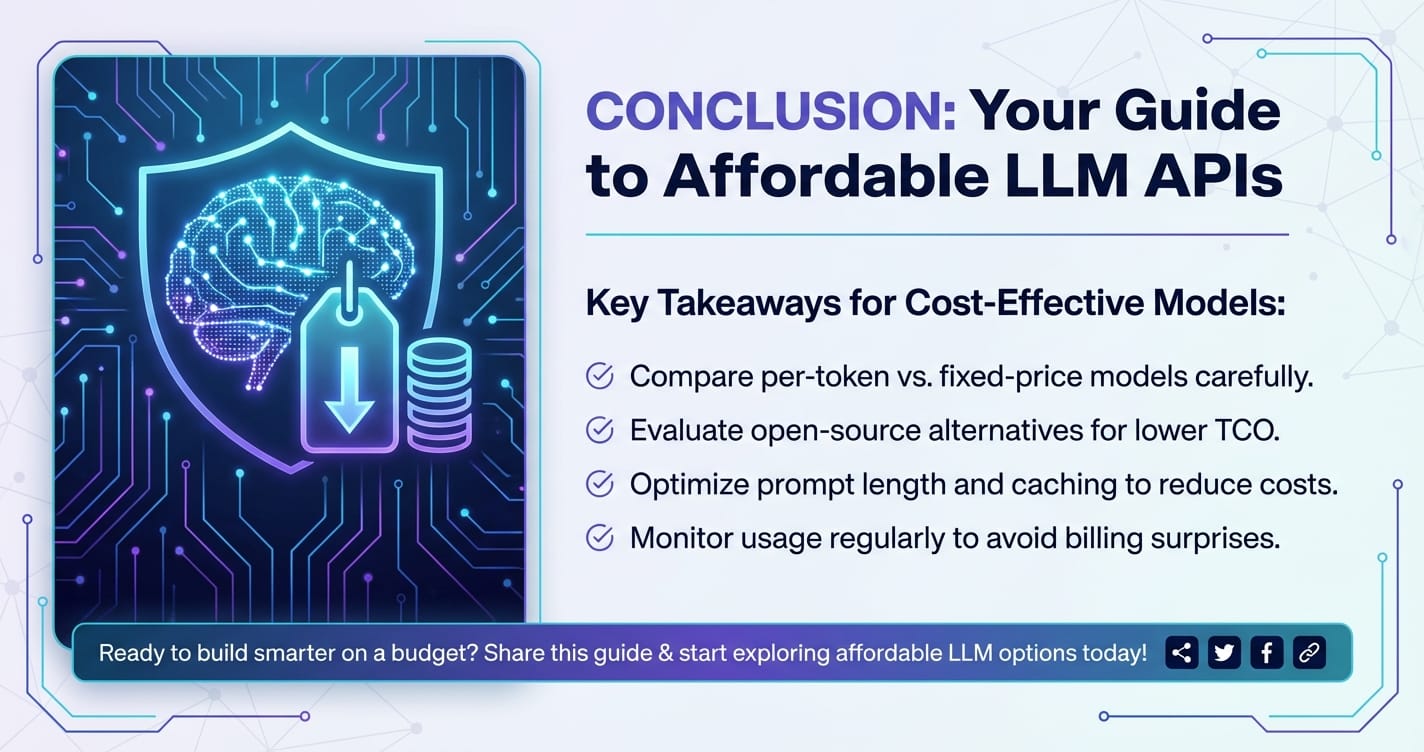
The question of "what is the cheapest LLM API" has no single, static answer. It's a dynamic puzzle influenced by your specific use case, desired performance, technical capabilities, and the ever-changing landscape of AI innovation and pricing. What is cheap for one application might be prohibitively expensive for another.
The most effective approach to LLM cost optimization is a holistic one:
- Understand Your Needs: Clearly define your application's requirements for quality, latency, throughput, and context window.
- Evaluate Models on Performance-to-Cost Ratio: Don't just look at raw token prices. Consider the total cost of ownership, including the cost of errors, developer time, and infrastructure.
- Implement Smart Routing and Tiered Usage: Match the model's capability to the task's complexity.
- Optimize Prompts and Leverage Caching: Minimize token usage and avoid redundant API calls.
- Explore Fine-tuning for Specialization: Invest upfront for long-term savings on highly repetitive or domain-specific tasks.
- Utilize Unified API Platforms: Leverage solutions like XRoute.AI to simplify integration, automate cost optimization, and gain flexible access to a broad spectrum of models from multiple providers, ensuring you always find the most cost-effective AI solution for your needs.
By adopting these strategies, developers and businesses can confidently navigate the complex world of LLM APIs, harnessing the incredible power of artificial intelligence without being overwhelmed by escalating costs. The future of AI is increasingly accessible, and with thoughtful planning, it can be remarkably affordable.
Frequently Asked Questions (FAQ)
Q1: Is the cheapest LLM always the best choice for my application?
A1: Not necessarily. While cost is a major factor, the "cheapest" model might not deliver the required quality, speed, or accuracy for your specific use case. A model with a slightly higher per-token price that provides better results, reduces the need for human intervention, or offers faster inference could lead to lower total costs of ownership and a better user experience in the long run. The best choice is often a balance between cost, performance, and suitability for the task.
Q2: How can I accurately track my LLM API spending across different providers?
A2: Tracking can be challenging with multiple providers. Most LLM providers offer dashboards and API usage logs. However, for a unified view, consider using a dedicated AI cost management platform or a unified API platform like XRoute.AI. These platforms often provide centralized billing, usage analytics, and real-time cost monitoring across all integrated models and providers, simplifying budget management and optimization efforts.
Q3: What are the main differences between open-source LLMs and commercial APIs in terms of cost?
A3: Open-source LLMs (e.g., Llama 3, Gemma) are "free" to download and use, but you incur costs for hosting, inference infrastructure (GPUs), maintenance, and specialized talent for deployment and optimization. Commercial APIs (e.g., OpenAI, Anthropic, Google) charge per token or per call, abstracting away the infrastructure complexities. The "cheaper" option depends on your technical expertise, existing infrastructure, and scale. For high-volume, specialized applications, self-hosting an open-source model can eventually be more cost-effective if managed well, while commercial APIs offer simplicity and rapid deployment for many users.
Q4: Besides token prices, what other hidden costs should I consider when using LLMs?
A4: Beyond token prices, consider: 1. Developer Time: For integration, debugging, and maintaining complex multi-API setups. 2. Infrastructure Costs: For self-hosting open-source models, or managing data pipelines and caching layers. 3. Cost of Errors: Manual review, correction, or damage from poor-quality outputs (e.g., lost customers). 4. Latency Costs: Impact on user experience, potential for higher infrastructure demands for real-time applications. 5. Data Storage: For storing conversation history or fine-tuning datasets. 6. Security and Compliance: Ensuring your data and LLM usage meet regulatory requirements.
Q5: How do unified API platforms like XRoute.AI help reduce LLM costs?
A5: Unified API platforms like XRoute.AI reduce LLM costs by: 1. Simplifying Integration: A single API endpoint reduces developer time and overhead. 2. Dynamic Routing: Automatically directing requests to the most cost-effective or performant model among a wide selection (60+ models from 20+ providers). 3. Centralized Management: Offering a unified view of usage and billing, making cost tracking and optimization easier. 4. Access to Competition: Allowing seamless switching between providers to leverage the best pricing at any given time without re-coding. 5. Performance Optimization: Focusing on low latency AI and high throughput to improve efficiency and reduce the need for costly workarounds. This makes finding what is the cheapest LLM API an automated process, constantly optimizing for cost-effective AI.
🚀You can securely and efficiently connect to thousands of data sources with XRoute in just two steps:
Step 1: Create Your API Key
To start using XRoute.AI, the first step is to create an account and generate your XRoute API KEY. This key unlocks access to the platform’s unified API interface, allowing you to connect to a vast ecosystem of large language models with minimal setup.
Here’s how to do it: 1. Visit https://xroute.ai/ and sign up for a free account. 2. Upon registration, explore the platform. 3. Navigate to the user dashboard and generate your XRoute API KEY.
This process takes less than a minute, and your API key will serve as the gateway to XRoute.AI’s robust developer tools, enabling seamless integration with LLM APIs for your projects.
Step 2: Select a Model and Make API Calls
Once you have your XRoute API KEY, you can select from over 60 large language models available on XRoute.AI and start making API calls. The platform’s OpenAI-compatible endpoint ensures that you can easily integrate models into your applications using just a few lines of code.
Here’s a sample configuration to call an LLM:
curl --location 'https://api.xroute.ai/openai/v1/chat/completions' \
--header 'Authorization: Bearer $apikey' \
--header 'Content-Type: application/json' \
--data '{
    "model": "gpt-5",
    "messages": [
        {
            "content": "Your text prompt here",
            "role": "user"
        }
    ]
}'
With this setup, your application can instantly connect to XRoute.AI’s unified API platform, leveraging low latency AI and high throughput (handling 891.82K tokens per month globally). XRoute.AI manages provider routing, load balancing, and failover, ensuring reliable performance for real-time applications like chatbots, data analysis tools, or automated workflows. You can also purchase additional API credits to scale your usage as needed, making it a cost-effective AI solution for projects of all sizes.
Note: Explore the documentation on https://xroute.ai/ for model-specific details, SDKs, and open-source examples to accelerate your development.