What's the Best LLM for Coding? An Expert's Guide

The digital frontier of software development is in constant flux, a vibrant landscape sculpted by innovation and evolving methodologies. In recent years, no force has exerted as profound an influence on this domain as the advent of Large Language Models (LLMs). These sophisticated AI systems, initially celebrated for their prowess in natural language understanding and generation, have rapidly proven themselves indispensable allies for developers, transforming everything from mundane syntax checks to complex architectural decisions. The question, then, is no longer if LLMs will integrate into our coding workflows, but which ones offer the most value. Developers, ranging from nascent learners to seasoned architects, are increasingly seeking to identify the best LLM for coding that aligns with their specific needs, project requirements, and personal preferences.
The quest for the ultimate coding companion among LLMs is a nuanced one. It's not about finding a universally superior model, but rather understanding the diverse strengths and weaknesses of each contender in the burgeoning AI arena. The choice of the best coding LLM can significantly impact productivity, code quality, innovation, and even the joy of problem-solving. This comprehensive guide aims to demystify this complex landscape, offering an expert's perspective on evaluating, selecting, and effectively leveraging LLMs to elevate your coding journey. We'll delve into the core capabilities that define a great coding LLM, scrutinize the leading models vying for supremacy, and provide practical strategies to ensure you harness their full potential. By the end, you'll be equipped with the insights to confidently answer the question: which LLM is best for coding for you?
The Paradigm Shift: How LLMs are Revolutionizing Software Development
The integration of Large Language Models into software development represents more than just an incremental improvement; it signifies a profound paradigm shift. What once required hours of meticulous manual effort, extensive documentation searches, and iterative debugging cycles can now be accelerated, augmented, and even partially automated by intelligent AI assistants. This isn't just about speed; it's about fundamentally reshaping the developer experience, freeing up cognitive load, and empowering creativity.
At its core, the revolution stems from LLMs' extraordinary ability to understand, generate, and reason about human language, which, in the context of coding, translates directly into comprehending programming languages and their underlying logic. This capability manifests in several transformative ways:
Code Generation: From Snippets to Solutions
Perhaps the most celebrated application, code generation is where LLMs truly shine. Given a natural language prompt, a good coding LLM can conjure up anything from a simple function to a complex class structure or even an entire microservice skeleton. Need a Python script to parse a CSV file? Or a JavaScript function to validate an email address? Simply describe your requirements, and the LLM will provide a robust starting point. This dramatically reduces boilerplate coding, allowing developers to jump straight into the unique, problem-solving aspects of their projects. For new frameworks or languages, it acts as an instant expert, providing idiomatic code examples that might otherwise take hours of documentation review.
Intelligent Code Completion and Suggestions
Beyond generating entire blocks of code, LLMs are deeply integrated into modern Integrated Development Environments (IDEs) to offer intelligent code completion. Tools like GitHub Copilot (powered by OpenAI's models) and Amazon CodeWhisperer predict the next lines of code as you type, often suggesting entire functions or logical sequences based on the surrounding context, comments, and even your project's existing codebase. This real-time assistance transforms the coding experience, reducing typos, accelerating development, and subtly guiding developers towards best practices. It's like having an experienced pair programmer constantly by your side, anticipating your needs before you even fully articulate them.
Debugging and Error Identification
Debugging is often cited as one of the most time-consuming and frustrating aspects of software development. LLMs offer a beacon of hope in this often-murky process. When confronted with an error message or a piece of problematic code, an LLM can analyze the context, pinpoint potential issues, and suggest solutions. This includes identifying syntax errors, logical flaws, potential off-by-one errors, and even runtime exceptions. By providing actionable insights and explanations for errors, LLMs empower developers to resolve issues faster and deepen their understanding of underlying problems, making them invaluable partners in the debugging trenches.
Code Refactoring and Optimization
As projects grow, maintaining clean, efficient, and scalable code becomes paramount. LLMs can assist significantly with code refactoring, suggesting ways to improve readability, reduce complexity, and adhere to established design patterns. They can identify opportunities for optimization, such as replacing inefficient loops with more performant data structures or streamlining redundant logic. This isn't merely about aesthetics; it's about enhancing the long-term maintainability and performance of software systems, a critical factor often overlooked in the race to deploy.
Documentation Generation
Good documentation is the backbone of collaborative development and project longevity, yet it's frequently neglected due to time constraints. LLMs can automatically generate comments, docstrings, and even comprehensive API documentation based on existing code. By analyzing function signatures, variable names, and code logic, they can create clear, concise explanations, ensuring that knowledge is effectively transferred and maintained within a team. This saves countless hours and ensures that critical project information remains accessible.
Learning and Skill Enhancement
For developers looking to expand their skill set or delve into unfamiliar territories, LLMs act as personalized tutors and knowledge repositories. They can explain complex concepts, provide examples in new languages, elaborate on design patterns, and clarify obscure error messages. By interacting with an LLM, developers can accelerate their learning curve, explore new technologies more efficiently, and gain deeper insights into their craft, fostering continuous professional growth.
In essence, LLMs are not just tools; they are intelligent co-pilots that augment human capabilities across the entire software development lifecycle. They streamline repetitive tasks, enhance problem-solving abilities, improve code quality, and ultimately allow developers to focus on the creative and strategic aspects of building innovative solutions. This shift is not about replacing human ingenuity but rather amplifying it, making the process of creating software more efficient, enjoyable, and accessible than ever before. Understanding these fundamental shifts is crucial for anyone seeking to identify which LLM is best for coding for their particular use cases.
Key Criteria for Evaluating the Best LLM for Coding
Selecting the best LLM for coding is akin to choosing a specialized tool for a craftsman; the ideal choice depends heavily on the specific task, the craftsman's preferences, and the characteristics of the material they are working with. To navigate the diverse landscape of available models, it's essential to establish a robust set of evaluation criteria. These metrics will serve as your compass, guiding you toward an LLM that not only performs well but also integrates seamlessly into your workflow and addresses your project's unique demands.
Here are the critical factors to consider when evaluating which LLM is best for coding:
1. Accuracy and Code Quality
This is arguably the most paramount criterion. An LLM's primary utility in coding lies in its ability to generate correct, robust, and efficient code. * Syntactic Correctness: Does it consistently produce valid code that adheres to the language's grammar? * Semantic Accuracy: Does the generated code actually do what it's supposed to do? Does it solve the problem correctly without hidden bugs or logical flaws? * Idiomaticity: Does the code follow the conventions and best practices of the target programming language and framework? Non-idiomatic code can be harder to read, maintain, and integrate. * Security: Does it generate code free from common vulnerabilities (e.g., SQL injection, XSS, insecure deserialization)? This is especially critical for production systems. * Efficiency: Is the generated code performant and optimized, or does it lead to unnecessary resource consumption?
2. Language and Framework Support
Developers often work across a polyglot of programming languages and frameworks. The versatility of an LLM in this regard is crucial. * Breadth of Language Support: Does it handle popular languages like Python, JavaScript, Java, C#, Go, Rust, C++, Ruby, etc., proficiently? * Framework-Specific Knowledge: Can it generate code or answer questions pertaining to specific frameworks (e.g., React, Angular, Vue, Django, Flask, Spring Boot, .NET, Kubernetes)? This specialized knowledge greatly enhances its utility. * Niche Language Capability: For specialized domains, support for less common languages or domain-specific languages (DSLs) might be a differentiator.
3. Context Window Size
The context window refers to the maximum amount of text (tokens) an LLM can process or "remember" in a single interaction. A larger context window allows the LLM to: * Understand Larger Codebases: Provide more relevant suggestions when analyzing substantial files or multiple related files. * Maintain Conversational Cohesion: Remember longer chat histories, leading to more consistent and effective multi-turn interactions for complex problem-solving. * Process Extensive Documentation: Analyze large bodies of text for generating summaries or answering questions, which is useful for code documentation tasks.
4. Latency and Throughput
For real-time coding assistance, such as code completion or immediate debugging suggestions, speed is of the essence. * Latency: How quickly does the LLM respond to a query? High latency can disrupt flow and make the tool feel cumbersome. * Throughput: How many requests can the LLM handle concurrently? This is more relevant for integrating LLMs into automated systems or enterprise-wide deployments. Low latency AI is especially important in development workflows where rapid feedback is crucial for productivity.
5. Cost-Effectiveness
LLM usage often comes with a price tag, especially for powerful proprietary models. Understanding the pricing model is vital. * Per-Token Pricing: Many models charge based on input and output tokens. Understanding the cost per token for different models is key. * Subscription Models: Some tools offer monthly subscriptions (e.g., GitHub Copilot). * Tiered Pricing: Different tiers might offer varying access levels, context windows, or feature sets. * Free Tiers/Open Source: Open-source models like Llama can be self-hosted, eliminating per-token costs but incurring infrastructure expenses. Cost-effective AI solutions are those that provide optimal performance relative to their operational expenditure.
6. Integration Capabilities
An LLM's utility is significantly enhanced by its ability to integrate seamlessly into existing development environments and workflows. * IDE Plugins: Direct integration with popular IDEs (VS Code, JetBrains IDEs) for real-time suggestions, code generation, and debugging. * API Accessibility: Does the LLM offer a robust and well-documented API for custom integrations? This is crucial for building AI-powered tools or services. * Version Control Integration: Can it interact with GitHub, GitLab, or other VCS platforms for tasks like pull request summaries or commit message generation?
7. Fine-tuning and Customization Options
While general-purpose LLMs are powerful, the ability to fine-tune a model on your specific codebase or domain can yield vastly superior results. * Custom Training: Can you train the LLM on your proprietary code, internal libraries, or specific architectural patterns to make it more relevant to your organization? * Prompt Engineering Flexibility: How well does the model respond to sophisticated prompt engineering techniques, allowing you to guide its output precisely?
8. Security and Data Privacy
When dealing with sensitive or proprietary code, security and privacy are non-negotiable. * Data Usage Policies: How does the LLM provider handle your input data? Is it used for further model training? Is it kept confidential? * On-Premise/Private Cloud Options: Are there options for deploying the LLM within your own secure infrastructure to maintain full control over your data? * Compliance: Does the provider comply with relevant data protection regulations (e.g., GDPR, HIPAA) if applicable to your project?
9. Community and Support
A vibrant community and reliable support can be invaluable, especially when encountering novel challenges. * Documentation: Is the documentation comprehensive, clear, and easy to navigate? * Community Forums: Are there active forums, Stack Overflow tags, or Discord channels where developers share knowledge and solutions? * Developer Support: Does the provider offer responsive technical support for enterprise users or paid subscribers?
10. Multi-Modality
While not strictly a "coding" criterion, multi-modality (e.g., understanding images, audio, video alongside text) is becoming increasingly relevant. For instance, being able to generate code from a screenshot of a UI design or a diagram could open up new avenues for productivity.
By rigorously applying these criteria, you can move beyond anecdotal evidence and make an informed decision about which LLM is best for coding for your unique circumstances, ensuring your investment in AI truly enhances your development capabilities.
Leading Contenders: A Deep Dive into Popular LLMs for Coding
The landscape of LLMs is dynamic and competitive, with several powerful models vying for the title of the best LLM for coding. Each comes with its own set of strengths, ideal use cases, and limitations. Understanding these nuances is crucial for making an informed decision. Let's explore the prominent players in this space.
1. OpenAI's GPT Series (GPT-3.5, GPT-4, GPT-4o)
OpenAI's GPT series, particularly GPT-4 and the newer GPT-4o, are often cited as benchmarks in the LLM world. They are general-purpose models with exceptional language understanding and generation capabilities, making them highly versatile for coding tasks.
- Strengths:
- Versatility: Excellent for a wide range of tasks beyond just coding, including explanations, documentation, and conceptual brainstorming.
- Impressive Code Generation: GPT-4 and GPT-4o can generate complex code snippets, functions, and even architectural patterns across numerous languages with high accuracy. Their ability to reason about code logic is robust.
- Strong General Understanding: They excel at understanding intricate problem descriptions and translating them into code, making them superb for prototyping and exploring new ideas.
- Reasoning Capabilities: Particularly with GPT-4 and GPT-4o, the models demonstrate advanced reasoning, which is vital for debugging, refactoring, and understanding complex requirements.
- Ecosystem: Widely supported by third-party tools and plugins due to their popularity and well-documented APIs.
- GPT-4o (Omni): The latest iteration, 'o' for omni, signifies its multi-modal capabilities. It can process and understand text, audio, and images seamlessly, which holds immense potential for coding applications (e.g., generating code from UI screenshots or architecture diagrams).
- Weaknesses:
- Cost: Generally more expensive per token compared to some alternatives, which can add up for heavy usage.
- Occasional Hallucinations: Like all LLMs, they can sometimes generate factually incorrect code or provide misleading explanations, necessitating human oversight.
- Context Window Limits: While improving, handling extremely large codebases within a single context window can still be a challenge for very complex, multi-file projects.
- Proprietary: Being closed-source, users have less control over their underlying architecture or the ability to deeply customize them.
- Specific Use Cases: General-purpose coding assistance, rapid prototyping, learning new languages/frameworks, complex problem-solving, generating documentation, and now, with GPT-4o, potentially code generation from visual inputs. Many developers find GPT-4/GPT-4o to be the best LLM for coding due to their broad capabilities, despite the cost.
2. Google's Gemini (and Codey, AlphaCode)
Google's Gemini family of models (Ultra, Pro, Nano) represents a strong contender, built from the ground up to be multimodal and highly performant. Google also has specialized models like Codey and the research-focused AlphaCode, indicating a strong commitment to the coding domain.
- Strengths:
- Multi-modality: Gemini was designed with multi-modality at its core, allowing it to reason across text, images, audio, and video inputs, which could be revolutionary for tasks like generating code from design mockups or explaining visual debugging.
- Strong Reasoning: Competitive with top models in complex reasoning tasks, which translates well to understanding intricate coding problems.
- Performance: Gemini Ultra, in particular, demonstrates state-of-the-art performance in various benchmarks, including coding.
- Integration with Google Ecosystem: Seamless integration with Google Cloud services and developer tools.
- Weaknesses:
- Newer to Market: While powerful, its ecosystem and third-party integrations are still maturing compared to OpenAI's.
- Availability: Access to the most powerful versions (like Gemini Ultra) might be more restricted or expensive.
- Less Public Exposure for Codey/AlphaCode: While powerful, specialized coding models like Codey and AlphaCode aren't as widely accessible or discussed in general developer circles as Copilot.
- Specific Use Cases: Advanced problem-solving, multi-modal applications (e.g., generating code from sketches), integrating AI into Google Cloud-based development, competitive programming (AlphaCode's forte).
3. Anthropic's Claude Series (Claude 3 Opus, Sonnet, Haiku)
Anthropic's Claude models, especially the Claude 3 family (Opus, Sonnet, Haiku), are known for their large context windows, sophisticated reasoning, and strong emphasis on safety and ethical AI development.
- Strengths:
- Large Context Windows: Claude 3 models boast impressive context windows (e.g., 200K tokens for Opus), making them ideal for analyzing entire codebases, long documentation, or extensive chat histories without losing track. This is a significant advantage for complex refactoring or understanding large project architectures.
- Strong Ethical Guardrails: Built with a focus on "Constitutional AI," Claude models are designed to be helpful, harmless, and honest, which can be reassuring for sensitive applications.
- Robust Performance: Claude 3 Opus is a top-tier model that performs exceptionally well in complex analytical tasks, including code understanding and generation.
- Reduced Hallucinations: While not entirely immune, Anthropic's focus on safety often results in more grounded and reliable responses.
- Weaknesses:
- Less Explicitly Code-Optimized: While highly capable, Claude might not be as explicitly fine-tuned for pure code generation and completion as some dedicated coding LLMs or OpenAI's general models that have seen extensive code data.
- Latency: For extremely rapid, real-time code suggestions, some users might find it slightly slower than highly optimized alternatives.
- Specific Use Cases: Code review, understanding large legacy codebases, generating comprehensive documentation, secure coding environments, and long-form coding assistance where extensive context is critical. For those dealing with massive projects, Claude 3 could easily be the best coding LLM.
4. Meta's Llama Series (Llama 2, Llama 3) and Code Llama
Meta's Llama series has revolutionized the open-source LLM landscape. Llama 2 and Llama 3 are foundational models, and Meta has also released specialized versions like Code Llama, explicitly fine-tuned for coding tasks.
- Strengths:
- Open Source: This is their biggest differentiator. Llama models can be downloaded and run locally or on private infrastructure, offering unparalleled control, customization, and data privacy.
- Customization and Fine-tuning: Developers can fine-tune Llama models on their proprietary datasets without incurring per-token API costs from external providers, making them incredibly adaptable for domain-specific coding.
- Cost-Effective (Self-Hosted): While requiring infrastructure, self-hosting can be significantly more cost-effective for high-volume or specific-use cases than continuous API calls to proprietary models.
- Strong Community: A vibrant and rapidly growing open-source community contributes to tools, extensions, and fine-tuned versions.
- Code Llama: This specialized derivative is trained on a massive code-centric dataset, making it exceptionally good at code generation, infilling, and debugging tasks across numerous languages. It supports Python, C++, Java, PHP, Typescript, C#, Bash, and more.
- Weaknesses:
- Requires More Setup: Deploying and managing open-source LLMs requires technical expertise, infrastructure, and ongoing maintenance.
- Performance Varies with Hardware: The performance of self-hosted models is directly tied to the available hardware (GPUs).
- Out-of-the-Box Performance: While powerful, the general Llama models might require fine-tuning to reach the peak performance of proprietary models for specific coding tasks. Code Llama mitigates this somewhat for coding.
- Specific Use Cases: Research, privacy-sensitive projects, projects with custom data requirements, environments where infrastructure costs are manageable, and developers seeking maximum control and flexibility. For those prioritizing open-source and privacy, Code Llama is definitely a contender for the best coding LLM.
5. Specialized Coding LLMs (e.g., GitHub Copilot, Amazon CodeWhisperer)
These tools are specifically designed for the developer workflow, often leveraging powerful underlying LLMs (like OpenAI's Codex/GPT for Copilot) but optimized for real-time, IDE-integrated coding assistance.
GitHub Copilot (powered by OpenAI Codex/GPT)
- Strengths:
- Deep IDE Integration: Seamlessly integrates with VS Code, JetBrains IDEs, Neovim, and other editors, providing real-time suggestions as you type.
- Context Awareness: Highly aware of the current file, open tabs, and even project-level context, leading to highly relevant suggestions.
- Highly Practical for Daily Use: Offers code completion, entire function generation, test generation, and docstring creation, dramatically accelerating daily coding tasks.
- Excellent for Boilerplate: Reduces repetitive coding by suggesting common patterns and structures.
- Weaknesses:
- Subscription Cost: Requires a monthly subscription.
- Can Suggest Suboptimal Code: While generally good, it can sometimes suggest less efficient, redundant, or even incorrect code that needs careful review.
- Dependency on External Service: Requires an internet connection and relies on GitHub's service.
- Data Privacy Concerns: While GitHub has updated its policies, initial concerns about using private code for training persisted.
- Specific Use Cases: Everyday coding, rapidly generating boilerplate, learning new libraries, pair programming, test generation. For many individual developers, Copilot is the de facto best coding LLM due to its unparalleled integration.
Amazon CodeWhisperer
- Strengths:
- Enterprise-Focused: Offers features tailored for enterprise use, including security scanning, IP protection features, and administrative controls.
- Security Scanning: Can scan generated code for potential security vulnerabilities (e.g., secrets in comments, common OWASP top 10 issues).
- Multi-Language Support: Supports a wide array of languages including Python, Java, JavaScript, TypeScript, C#, Go, Rust, PHP, Ruby, Kotlin, C, C++, Shell scripts, SQL, and Scala.
- Free Tier: Offers a free tier for individual developers without an AWS account.
- Customization for Internal Libraries: Can be customized to suggest code based on internal APIs and private libraries.
- Weaknesses:
- Ecosystem Tied to AWS: While usable outside, its full potential and enterprise features are best realized within the AWS ecosystem.
- Learning Curve: For non-AWS users, setting up and integrating might involve a slight learning curve.
- Specific Use Cases: Enterprise development, projects with strict security and compliance requirements, AWS-centric development, and teams needing centralized management of AI coding assistance.
Table Comparison of Leading LLMs for Coding
To summarize, here's a comparative overview of the leading LLMs discussed:
| Feature/Model | OpenAI GPT-4o | Google Gemini Ultra | Anthropic Claude 3 Opus | Meta Code Llama (Llama 3 base) | GitHub Copilot | Amazon CodeWhisperer |
|---|---|---|---|---|---|---|
| Primary Use Case | General coding, advanced reasoning, multi-modal prototyping | Complex problem solving, multi-modal applications, Google Cloud integrations | Large codebase analysis, secure environments, long-form content | Open-source code generation, research, custom fine-tuning | Real-time code completion, boilerplate | Enterprise development, AWS integration, security |
| Key Strengths | Versatility, strong reasoning, code generation, multi-modal | Multi-modality, strong reasoning, competitive performance | Large context window, strong ethical guardrails, robust analysis | Open-source, customizable, privacy-focused, excellent code-specific | Deep IDE integration, context awareness, daily productivity boost | Security scanning, enterprise features, free tier, AWS integration |
| Key Weaknesses | Cost, occasional hallucinations | Newer ecosystem, potentially higher cost/limited access for top tiers | Less explicitly code-optimized, potentially higher latency for real-time | Requires setup/infra, performance tied to hardware, less out-of-box generalist | Subscription cost, can suggest suboptimal code, cloud dependency | Tied to AWS ecosystem, less generalist outside AWS |
| Open/Closed Source | Closed Source | Closed Source | Closed Source | Open Source | Closed Source (uses OpenAI) | Closed Source |
| Cost Model | Per-token API usage, varying rates | Per-token API usage, tiered access | Per-token API usage, tiered access | Free (self-hosted) or via APIs | Subscription (monthly/annual) | Free tier for individuals, enterprise pricing for teams |
| Context Window | Varies (up to 128K tokens) | Varies (up to 1M for specific use) | Varies (up to 200K tokens) | Varies (up to 128K for Llama 3) | Context-aware based on active files/project | Context-aware based on active files/project |
| Multi-modality | Yes (text, audio, vision) | Yes (text, image, audio, video) | Limited (text, some vision) | Primarily text (vision in newer Llama 3 variants) | Primarily text | Primarily text |
The choice among these models often boils down to a balance of required capabilities, budget constraints, privacy considerations, and integration preferences. For an individual developer, a specialized tool like GitHub Copilot might be the best coding LLM for daily tasks. For a research team, an open-source model like Code Llama might be more appealing. And for a large enterprise with complex requirements, a highly capable API-driven model via a unified platform could be the ideal solution.
Beyond Raw Performance: The Ecosystem and Integration Advantage
While the raw performance, accuracy, and feature sets of individual LLMs are critical, their true value in a developer's workflow often hinges on how seamlessly they integrate into the existing ecosystem of tools and practices. An LLM, no matter how powerful, is only as effective as its accessibility and ease of use within a developer's day-to-day environment. This is where the concept of ecosystem and integration truly comes into play, offering a significant advantage that can sometimes outweigh marginal differences in model performance.
IDE Integration: The Frontline of Developer Productivity
For most developers, the Integrated Development Environment (IDE) is their command center. The ability of an LLM to integrate directly into popular IDEs like VS Code, JetBrains products (IntelliJ IDEA, PyCharm), Sublime Text, or Neovim is paramount. * Real-time Suggestions: LLMs that offer inline code completion, suggest entire functions, or provide context-aware snippets directly within the editor significantly enhance productivity. This reduces context switching and keeps the developer in their flow state. * Debugging Assistance: IDE plugins can leverage LLMs to explain error messages, suggest fixes, or even provide insights during a debugging session, right where the problem occurs. * Refactoring Tools: LLM-powered features within the IDE can suggest refactoring opportunities, improve code readability, and automatically apply common design patterns.
Without deep IDE integration, even the best LLM for coding might remain an underutilized resource, relegated to a separate browser tab, thereby disrupting the developer's concentration and workflow.
Version Control Integration: Enhancing Collaboration and Quality
Version Control Systems (VCS) like Git (and platforms like GitHub, GitLab, Bitbucket) are central to modern software development. LLMs can add immense value here: * Automated Commit Messages: Generating descriptive and concise commit messages based on code changes. * Pull Request Summaries: Summarizing the changes within a pull request, highlighting key modifications and potential impacts. * Code Review Assistance: Providing preliminary feedback on pull requests, identifying potential bugs, style violations, or areas for improvement, thereby augmenting human code reviewers. * Documentation for Changes: Automatically updating READMEs or changelogs based on merged code.
Integrating LLMs into these critical collaboration points can streamline the development process, improve code quality, and accelerate project delivery.
Developer Tools & Platforms: Fitting into the Broader Landscape
Beyond IDEs and VCS, developers interact with a multitude of tools: build systems, CI/CD pipelines, issue trackers, project management software, and more. * Automated Testing: LLMs can generate unit tests or suggest test cases based on function definitions. * CI/CD Integration: Automatically generate build scripts, analyze pipeline failures, or suggest optimizations. * Issue Tracking: Summarize bug reports, suggest solutions, or automatically tag issues based on their content.
The more an LLM can fit into and enhance these various tools, the greater its overall utility and impact on the development lifecycle.
API Accessibility: The Gateway to Custom Solutions
For businesses and advanced developers, the direct API accessibility of an LLM is crucial. A well-documented, stable, and performant API allows for: * Building Custom Tools: Creating bespoke AI-powered applications, internal developer tools, or specialized coding assistants tailored to an organization's unique needs. * Integrating into Existing Software: Embedding LLM capabilities directly into proprietary software products or services. * Automation: Automating complex coding tasks as part of a larger workflow.
The ease with which one can connect to and utilize an LLM via its API significantly broadens its potential applications beyond out-of-the-box integrations.
The Role of Unified API Platforms: Simplifying the LLM Sprawl
As the number of powerful LLMs proliferates, a new challenge has emerged: managing and integrating with multiple distinct APIs. Each LLM provider has its own endpoint, authentication method, rate limits, and data formats. For developers and businesses striving to leverage the capabilities of various LLMs—perhaps choosing GPT-4 for complex reasoning, Claude for large context analysis, and a fine-tuned Llama for specific internal tasks—this complexity can quickly become overwhelming. This is precisely where platforms like XRoute.AI offer a game-changing solution.
XRoute.AI acts as a cutting-edge unified API platform designed to streamline access to large language models (LLMs) for developers, businesses, and AI enthusiasts. It addresses the fragmentation in the LLM ecosystem by providing a single, OpenAI-compatible endpoint. This means that instead of managing individual API keys and integration logic for dozens of models, you interact with just one API.
How XRoute.AI Elevates the LLM Integration Experience:
- Simplified Integration: By offering a single, OpenAI-compatible endpoint, XRoute.AI drastically simplifies the integration process. Developers can switch between models or even route requests intelligently based on criteria without rewriting significant portions of their application code. This is particularly beneficial when trying to determine which LLM is best for coding for a particular sub-task, as experimentation becomes trivial.
- Access to a Vast Model Zoo: XRoute.AI simplifies the integration of over 60 AI models from more than 20 active providers. This extensive selection allows developers to choose the most suitable model for any given task—whether it's the latest GPT, a powerful Claude, or a specialized open-source model—all through one gateway.
- Low Latency AI: The platform is engineered for performance, ensuring low latency AI responses. In coding, where real-time feedback is often critical, minimizing delays is paramount. XRoute.AI's optimized routing and infrastructure help deliver quick responses, enhancing the developer experience.
- Cost-Effective AI: With intelligent routing and potentially aggregated pricing, XRoute.AI helps users achieve cost-effective AI solutions. It can route requests to the most performant and cost-efficient model for a given query, optimizing expenditure without compromising on quality. This is crucial for businesses aiming to scale their AI usage responsibly.
- Developer-Friendly Tools: XRoute.AI empowers users to build intelligent solutions without the complexity of managing multiple API connections. This frees up developer resources to focus on innovation and product features rather than infrastructure and integration headaches.
- High Throughput and Scalability: The platform is built to handle high volumes of requests, ensuring that applications can scale effectively as user demand grows. This reliability is vital for production-grade AI applications.
- Flexible Pricing Model: XRoute.AI offers a flexible pricing model suitable for projects of all sizes, from startups experimenting with AI to enterprise-level applications demanding robust performance and support.
In essence, XRoute.AI transforms the challenge of LLM sprawl into an opportunity for streamlined, efficient, and scalable AI integration. For developers and businesses seeking to build AI-driven applications, chatbots, and automated workflows, it provides the connective tissue that makes working with a diverse array of LLMs not just possible, but genuinely effortless. When seeking the best coding LLM, platforms like XRoute.AI ensure you're not just choosing a model, but gaining access to an entire arsenal of models, managed intelligently.
XRoute is a cutting-edge unified API platform designed to streamline access to large language models (LLMs) for developers, businesses, and AI enthusiasts. By providing a single, OpenAI-compatible endpoint, XRoute.AI simplifies the integration of over 60 AI models from more than 20 active providers(including OpenAI, Anthropic, Mistral, Llama2, Google Gemini, and more), enabling seamless development of AI-driven applications, chatbots, and automated workflows.
Strategies for Maximizing LLM Effectiveness in Coding
Having identified and selected the best LLM for coding based on your specific needs, the next crucial step is to master its usage. LLMs are powerful tools, but like any sophisticated instrument, their full potential is unlocked not just by their inherent capabilities but by the skill and strategy of their operator. Maximizing an LLM's effectiveness in coding involves a blend of careful prompting, iterative refinement, vigilant security practices, and a healthy dose of human oversight.
1. Prompt Engineering: The Art of Guiding the AI
The quality of an LLM's output is directly proportional to the clarity and specificity of its input – your prompt. Mastering prompt engineering is perhaps the single most impactful strategy. * Be Clear and Specific: Avoid vague language. Instead of "write some Python code," try "write a Python function called calculate_average that takes a list of numbers as input and returns their average, handling empty lists by returning 0." * Provide Context: Give the LLM all necessary information. If you're modifying existing code, provide the relevant snippets. If an error occurred, include the full error message and the surrounding code. * Specify Output Format: Tell the LLM how you want the output structured. "Return only the Python function, no explanation needed," or "Generate the code in a markdown block, followed by a brief explanation." * Define Constraints and Requirements: Specify performance requirements, libraries to use, error handling mechanisms, or adherence to specific coding styles (e.g., "Use Python's requests library," "Ensure all exceptions are handled gracefully," "Adhere to PEP 8 standards"). * Use Examples (Few-Shot Learning): For complex or nuanced tasks, providing one or more examples of desired input-output pairs can dramatically improve the LLM's understanding and performance. * Role-Playing: Instruct the LLM to "Act as an experienced Senior Python Developer" or "You are a meticulous Code Reviewer." This can influence the tone, depth, and style of its responses. * Iterate and Refine: Don't expect perfection on the first try. If the output isn't right, refine your prompt. Break down complex problems into smaller, more manageable sub-prompts.
2. Iterative Refinement: The Conversation is Key
LLMs are conversational. Treat your interaction with them as a dialogue, not a one-off command. * Ask for Clarification: If the LLM's output is unclear or incorrect, ask clarifying questions. "Can you explain why you chose this data structure?" or "This code has an error; can you find it and fix it?" * Provide Feedback: Point out specific issues. "The previous code was good, but it didn't handle negative numbers correctly. Can you revise it to account for that?" * Break Down Complex Tasks: For large problems, start with a high-level request, then ask the LLM to elaborate on specific components, functions, or steps. This prevents the LLM from getting overwhelmed and ensures more focused, accurate results.
3. Security Best Practices: Review and Verify
While LLMs are powerful, they are not infallible. Generated code can contain vulnerabilities, bugs, or inefficiencies. * Always Review Generated Code: Never blindly copy-paste LLM-generated code into a production environment. Treat it as a strong suggestion or a starting point, not a definitive solution. * Scan for Vulnerabilities: Integrate static analysis security testing (SAST) tools into your workflow. Even the best coding LLM might inadvertently introduce security flaws. * Understand What You're Deploying: Ensure you comprehend every line of code generated. If you don't understand it, don't use it without further investigation. * Be Mindful of Data Privacy: When using LLMs through third-party APIs, be cautious about feeding them sensitive or proprietary information if the provider's data usage policies are unclear or unacceptable. For such cases, self-hosted open-source models (like Code Llama) or highly secure enterprise solutions (like Amazon CodeWhisperer's IP protection) become essential.
4. Human Oversight: The Indispensable Element
LLMs are tools to augment human intelligence, not replace it. Your critical thinking, domain expertise, and judgment remain indispensable. * Maintain Ownership: You, the developer, are ultimately responsible for the code you write, even if assisted by an LLM. * Validate Assumptions: LLMs may make assumptions based on common patterns; verify these against your specific project requirements. * Creativity and Innovation: LLMs can generate boilerplate, but true innovation, architectural vision, and elegant problem-solving still largely reside with human developers. Use the LLM to free up time for these higher-level tasks. * Ethical Considerations: Be aware of potential biases in generated code or explanations, and ensure your solutions adhere to ethical guidelines.
5. Learning and Adapting: Stay Current
The field of LLMs is evolving at a breakneck pace. * Stay Updated: Regularly follow news and updates from LLM providers. New models, features, and prompt engineering techniques emerge constantly. * Experiment Continuously: Try different models and prompting strategies. What works well for one task might not be optimal for another. Experimentation is key to finding which LLM is best for coding for varied scenarios. * Share Knowledge: Engage with the developer community to learn new tricks and share your own discoveries.
By adopting these strategies, developers can transform LLMs from mere assistants into powerful partners, dramatically enhancing their productivity, the quality of their code, and their overall development experience.
Choosing the Best LLM for Your Needs: A Tailored Approach
The central theme woven throughout this guide is that there is no single, universally "best LLM for coding." The optimal choice is highly contextual, depending on a myriad of factors unique to each developer, team, project, and organization. To truly answer the question, which LLM is best for coding for you, you must perform an internal assessment of your specific requirements and priorities.
Here’s a tailored approach to guide your decision-making:
1. For Beginners and Solo Developers: Focus on Accessibility and Ease of Use
If you're new to coding, learning a new language, or working on personal projects, your priorities likely revolve around ease of use, instant gratification, and broad applicability. * Recommendation: User-friendly, deeply integrated tools like GitHub Copilot are often the best starting point. They blend seamlessly into your IDE, offering real-time assistance that feels like magic. General-purpose models like OpenAI's GPT-4o are also excellent for learning, explaining concepts, and generating quick prototypes through their accessible APIs or chat interfaces. * Why: They offer immediate productivity gains, reduce the cognitive load of learning new syntax, and act as a constant mentor, allowing you to focus on logic and problem-solving.
2. For Open-Source Enthusiasts and Privacy-Conscious Developers: Prioritize Control and Customization
For those who value transparency, wish to avoid vendor lock-in, or work with highly sensitive data that cannot leave private infrastructure, open-source models are the clear winners. * Recommendation: Meta's Llama series, particularly Code Llama, is ideal. These models can be self-hosted, fine-tuned on proprietary data, and offer complete control over data privacy. * Why: You own the infrastructure, can customize the model to your exact needs, and mitigate concerns about third-party data usage. This is where the concept of the best coding LLM shifts towards ownership and adaptability.
3. For Enterprise-Level Development and Large Teams: Emphasize Security, Scalability, and Integration
Organizations dealing with complex projects, strict compliance requirements, large codebases, and the need for centralized management have a different set of priorities. * Recommendation: Amazon CodeWhisperer (especially for AWS-centric teams) provides robust security features, IP protection, and enterprise-grade controls. Highly capable general models like OpenAI's GPT-4o or Anthropic's Claude 3 Opus (with its large context window for big projects) are excellent via API for integration into custom workflows. Crucially, leveraging a unified API platform like XRoute.AI becomes paramount here. * Why: Enterprise environments demand reliability, robust security, scalability, and the ability to manage access and costs efficiently across multiple projects and teams. Platforms like XRoute.AI provide the flexibility to route requests to the best LLM for coding for each specific task while offering a simplified, cost-effective, and low-latency access layer.
4. For Cutting-Edge Research, Complex Tasks, or Multi-Modal Applications: Seek Advanced Reasoning and Versatility
When pushing the boundaries of what's possible, tackling highly intricate problems, or requiring AI to understand more than just text, the most advanced, often proprietary, models shine. * Recommendation: OpenAI's GPT-4o, Google's Gemini Ultra, and Anthropic's Claude 3 Opus are top contenders. Their superior reasoning capabilities, larger context windows, and emerging multi-modal features make them suitable for sophisticated challenges. * Why: These models offer the highest levels of intelligence, creativity, and the ability to handle nuanced requirements, including understanding visual or audio cues in the context of coding.
5. For Cost Optimization: Smart Routing and Open-Source Solutions
Budget constraints are a very real factor. Minimizing operational expenditure while maintaining high performance is a common goal. * Recommendation: Consider self-hosting Code Llama if you have the infrastructure. For API-based usage, explore platforms like XRoute.AI, which can offer cost-effective AI by intelligently routing requests to the cheapest suitable model or leveraging bulk pricing. Experiment with smaller, more specialized models that might be cheaper for specific tasks than a large generalist LLM. * Why: Strategic deployment of open-source models or intelligent API management can significantly reduce costs without compromising core functionalities.
The Dynamic Nature of "Best"
It's vital to remember that the definition of the "best LLM for coding" is not static. The AI landscape is in constant flux, with new models, features, and optimization techniques emerging regularly. What is optimal today might be surpassed tomorrow. Therefore, continuous evaluation, experimentation, and a willingness to adapt your choices are essential.
Ultimately, the goal is to empower your development process. By thoughtfully aligning an LLM's capabilities with your unique context, you can unlock unprecedented levels of productivity, creativity, and efficiency in your coding journey.
The Future of LLMs in Coding: What's Next?
The journey of LLMs in software development is far from over; in many ways, it's just beginning. The rapid advancements witnessed in the past few years are merely a prelude to a future where AI's integration into coding will become even more profound, intuitive, and transformative. Predicting the exact trajectory is challenging, but several key trends and exciting possibilities are already on the horizon.
1. Hyper-Specialized Models and Domain-Specific Intelligence
While general-purpose LLMs like GPT-4o are incredibly versatile, the future will likely see an explosion of hyper-specialized models. We've already seen this with Code Llama. Expect more models fine-tuned not just for coding, but for specific languages, frameworks (e.g., a "React LLM" or a "Spring Boot LLM"), architectural patterns (e.g., microservices, serverless), or even niche domains (e.g., bioinformatics code, financial trading algorithms). These models will possess unparalleled depth of knowledge in their respective areas, leading to even higher accuracy and more idiomatic code generation. This will sharpen the debate on which LLM is best for coding for very specific tasks.
2. Enhanced Multi-Modality and Beyond Text
The advent of multi-modal models like GPT-4o and Gemini Ultra signals a significant shift. Future LLMs will increasingly understand and generate code not just from text, but from: * Visual Inputs: Generating front-end code from design mockups (Figma, Sketch), UI screenshots, or even hand-drawn diagrams. Developers might simply sketch an application flow, and the LLM translates it into functional code. * Audio Inputs: Voice commands for coding ("Generate a Python class for a database connection with a connect and disconnect method"), or explaining complex concepts verbally. * Beyond 2D: Potentially understanding 3D models or VR/AR environments to generate interactive experiences. This expanded sensory input will bridge the gap between human intent and code generation in unprecedented ways.
3. Autonomous Agents and Full Software Development Lifecycle Automation
The current generation of LLMs primarily acts as sophisticated assistants. The next wave will likely see the rise of more autonomous AI agents capable of handling entire segments of the software development lifecycle. Imagine agents that can: * Understand Requirements: Take a user story or product specification and break it down into tasks. * Design and Architect: Propose system architectures, choose appropriate technologies, and design database schemas. * Generate and Refactor Code: Write code, perform iterative refinements, and optimize for performance. * Test and Deploy: Generate test cases, run tests, identify bugs, and even orchestrate deployment pipelines. * Monitor and Maintain: Continuously monitor production systems, identify anomalies, and suggest code changes for maintenance or scaling. These "Dev AIs" would coordinate multiple LLM capabilities and specialized tools to perform end-to-end tasks, fundamentally reshaping team structures and development processes.
4. Improved Reasoning and Fewer Hallucinations
A persistent challenge with current LLMs is their occasional tendency to "hallucinate" – generating plausible but incorrect information. Future models will feature significantly improved reasoning capabilities, making them more reliable and trustworthy. This will involve: * Enhanced Fact-Checking: Better integration with real-world knowledge bases and external tools to verify generated information. * Self-Correction Mechanisms: LLMs that can detect and correct their own errors through internal feedback loops or by consulting expert systems. * Probabilistic Output: Providing confidence scores for generated code or explanations, allowing developers to assess risk.
5. Deeper Integration with Developer Toolchains
The integration of LLMs will become even more pervasive and seamless. * Contextual Awareness: LLMs will have an even deeper understanding of the entire project context – not just open files, but configuration files, build outputs, version control history, and even company-specific best practices. * Personalized AI: LLMs that learn individual developer preferences, coding styles, and common mistakes, providing hyper-personalized assistance. * Collaborative AI: Tools that facilitate AI-human collaboration on code, allowing teams to leverage LLMs collectively.
6. Ethical AI in Coding: Bias and Security
As AI becomes more integral, the ethical implications will also gain prominence. * Bias Mitigation: Efforts to identify and mitigate biases in training data that could lead to discriminatory or unfair code outputs. * AI-Enhanced Security: LLMs will not only generate code but will also be instrumental in proactively identifying and patching vulnerabilities, and even designing more secure systems. * Explainable AI (XAI) for Code: Developing methods for LLMs to explain their reasoning for code suggestions, making them more transparent and auditable.
The future of LLMs in coding promises not merely faster development, but smarter, more creative, and more robust software creation. Developers will be empowered to focus on higher-order problem-solving and innovation, with AI handling much of the heavy lifting. The continuous evolution means that understanding the "best LLM for coding" will always be an ongoing, fascinating exploration.
Conclusion
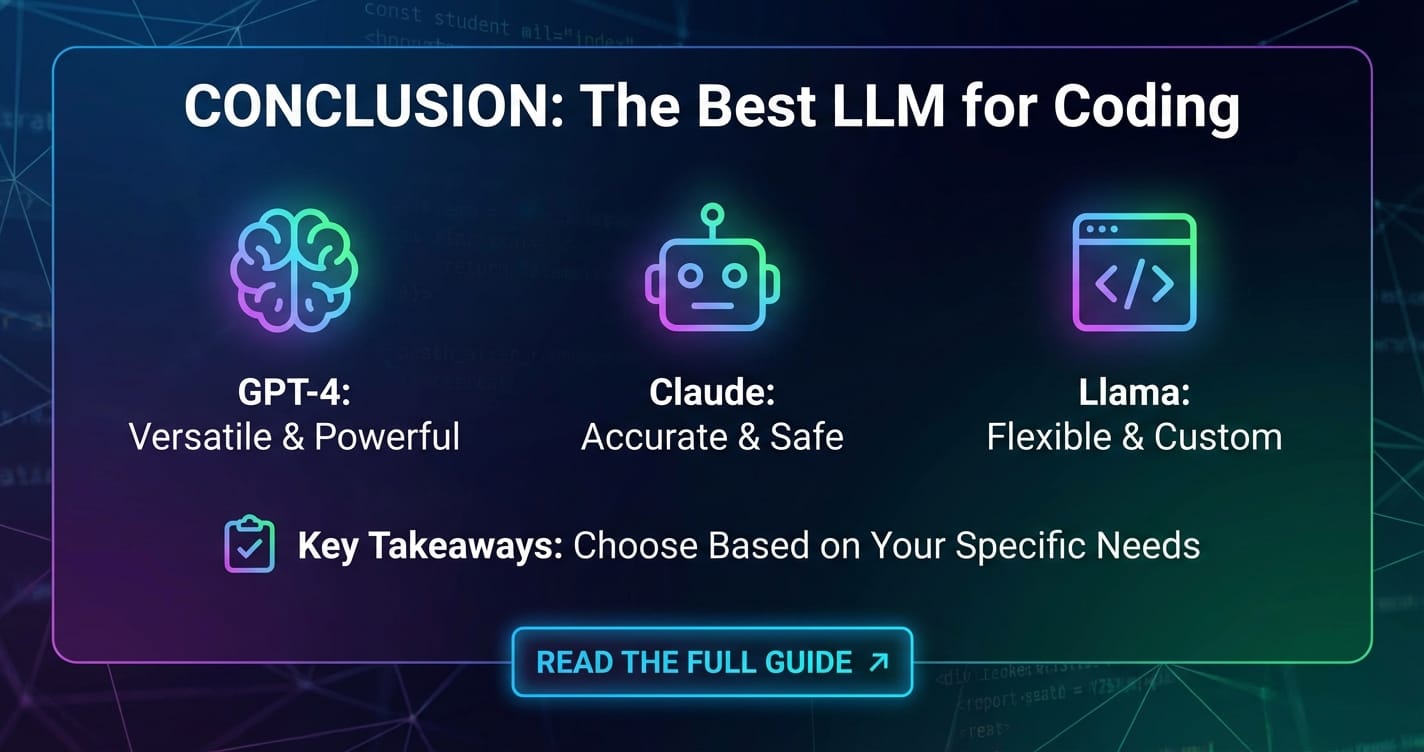
The journey to discover the "best LLM for coding" is not a sprint to a definitive finish line, but an ongoing exploration within a rapidly expanding technological frontier. As we've delved into the capabilities, leading contenders, and strategic integration of these intelligent agents, a clear picture emerges: the ideal LLM is a deeply personal and context-dependent choice.
From the versatile prowess of OpenAI's GPT models and Google's multi-modal Gemini, to Anthropic's context-rich Claude and Meta's customizable open-source Llama series, each LLM brings unique strengths to the table. Specialized tools like GitHub Copilot and Amazon CodeWhisperer further refine the experience, offering tailored assistance directly within the developer's environment. The critical takeaway is that there isn't a single, monolithic "best coding LLM" for everyone. Instead, the most effective approach involves a thoughtful assessment of your specific project requirements, budget constraints, security needs, and personal workflow preferences.
Moreover, the power of an LLM is magnified by how well it integrates into the broader developer ecosystem. Platforms like XRoute.AI exemplify this by offering a unified API platform that simplifies access to a vast array of models. By providing low latency AI and cost-effective AI solutions through a single, OpenAI-compatible endpoint, XRoute.AI empowers developers and businesses to flexibly harness the collective intelligence of over 60 AI models. This kind of integration not only streamlines development but also enables dynamic model selection, ensuring that you're always leveraging which LLM is best for coding for each particular task without the burden of complex API management.
As the future unfolds, we anticipate even more specialized, intelligent, and autonomous AI agents that will further transform the software development lifecycle. The landscape will continue to evolve at a breathtaking pace, demanding continuous learning and adaptation from developers.
Ultimately, LLMs are not here to replace human ingenuity but to amplify it. They are powerful co-pilots, mentors, and productivity enhancers that free us from the mundane, allowing us to dedicate more energy to creativity, complex problem-solving, and truly innovative design. Embrace the experimentation, leverage the tools available, and you'll find that the "best LLM for coding" is the one that best empowers you to build the future, one intelligent line of code at a time.
Frequently Asked Questions (FAQ)
Q1: What is an LLM for coding, and how does it help developers?
A1: An LLM (Large Language Model) for coding is an AI system trained on vast datasets of code and text, enabling it to understand, generate, and reason about programming languages. It assists developers by automating code generation, providing intelligent code completion, helping with debugging, suggesting refactoring improvements, generating documentation, and even explaining complex concepts. This significantly boosts productivity and accelerates the development process.
Q2: Is there a single "best LLM for coding" that fits everyone?
A2: No, there isn't a single "best" LLM for coding for everyone. The ideal choice depends heavily on individual needs, project requirements, budget, privacy concerns, and preferred programming languages/frameworks. Factors like accuracy, context window size, cost, and integration capabilities all play a role in determining which LLM is best for coding for a specific use case.
Q3: How do open-source LLMs like Code Llama compare to proprietary ones like GPT-4o for coding?
A3: Open-source LLMs like Code Llama offer unparalleled control, customization, and data privacy, as they can be self-hosted and fine-tuned on proprietary data. They are often more cost-effective for high-volume usage once infrastructure is in place. Proprietary models like GPT-4o, on the other hand, typically offer state-of-the-art out-of-the-box performance, broader general knowledge, and simpler API access, but come with per-token costs and less control over the model's internals.
Q4: How can I ensure the code generated by an LLM is secure and reliable?
A4: Always treat LLM-generated code as a starting point, not a final solution. It's crucial to always review and verify the code manually. Integrate static analysis security testing (SAST) tools into your workflow to scan for vulnerabilities. Understand every line of code before deploying it, and never blindly copy-paste into production. Human oversight remains indispensable for ensuring security, reliability, and adherence to project-specific requirements.
Q5: How do unified API platforms like XRoute.AI enhance the use of LLMs for coding?
A5: Unified API platforms like XRoute.AI simplify access to a multitude of LLMs from various providers through a single, OpenAI-compatible endpoint. This eliminates the complexity of managing disparate APIs, allowing developers to easily switch between models or intelligently route requests to the most suitable or cost-effective LLM for a given task. XRoute.AI ensures low latency AI, cost-effective AI, and high scalability, enabling developers to focus on building innovative applications rather than integration challenges, making it easier to leverage the best LLM for coding for any scenario.
🚀You can securely and efficiently connect to thousands of data sources with XRoute in just two steps:
Step 1: Create Your API Key
To start using XRoute.AI, the first step is to create an account and generate your XRoute API KEY. This key unlocks access to the platform’s unified API interface, allowing you to connect to a vast ecosystem of large language models with minimal setup.
Here’s how to do it: 1. Visit https://xroute.ai/ and sign up for a free account. 2. Upon registration, explore the platform. 3. Navigate to the user dashboard and generate your XRoute API KEY.
This process takes less than a minute, and your API key will serve as the gateway to XRoute.AI’s robust developer tools, enabling seamless integration with LLM APIs for your projects.
Step 2: Select a Model and Make API Calls
Once you have your XRoute API KEY, you can select from over 60 large language models available on XRoute.AI and start making API calls. The platform’s OpenAI-compatible endpoint ensures that you can easily integrate models into your applications using just a few lines of code.
Here’s a sample configuration to call an LLM:
curl --location 'https://api.xroute.ai/openai/v1/chat/completions' \
--header 'Authorization: Bearer $apikey' \
--header 'Content-Type: application/json' \
--data '{
    "model": "gpt-5",
    "messages": [
        {
            "content": "Your text prompt here",
            "role": "user"
        }
    ]
}'
With this setup, your application can instantly connect to XRoute.AI’s unified API platform, leveraging low latency AI and high throughput (handling 891.82K tokens per month globally). XRoute.AI manages provider routing, load balancing, and failover, ensuring reliable performance for real-time applications like chatbots, data analysis tools, or automated workflows. You can also purchase additional API credits to scale your usage as needed, making it a cost-effective AI solution for projects of all sizes.
Note: Explore the documentation on https://xroute.ai/ for model-specific details, SDKs, and open-source examples to accelerate your development.