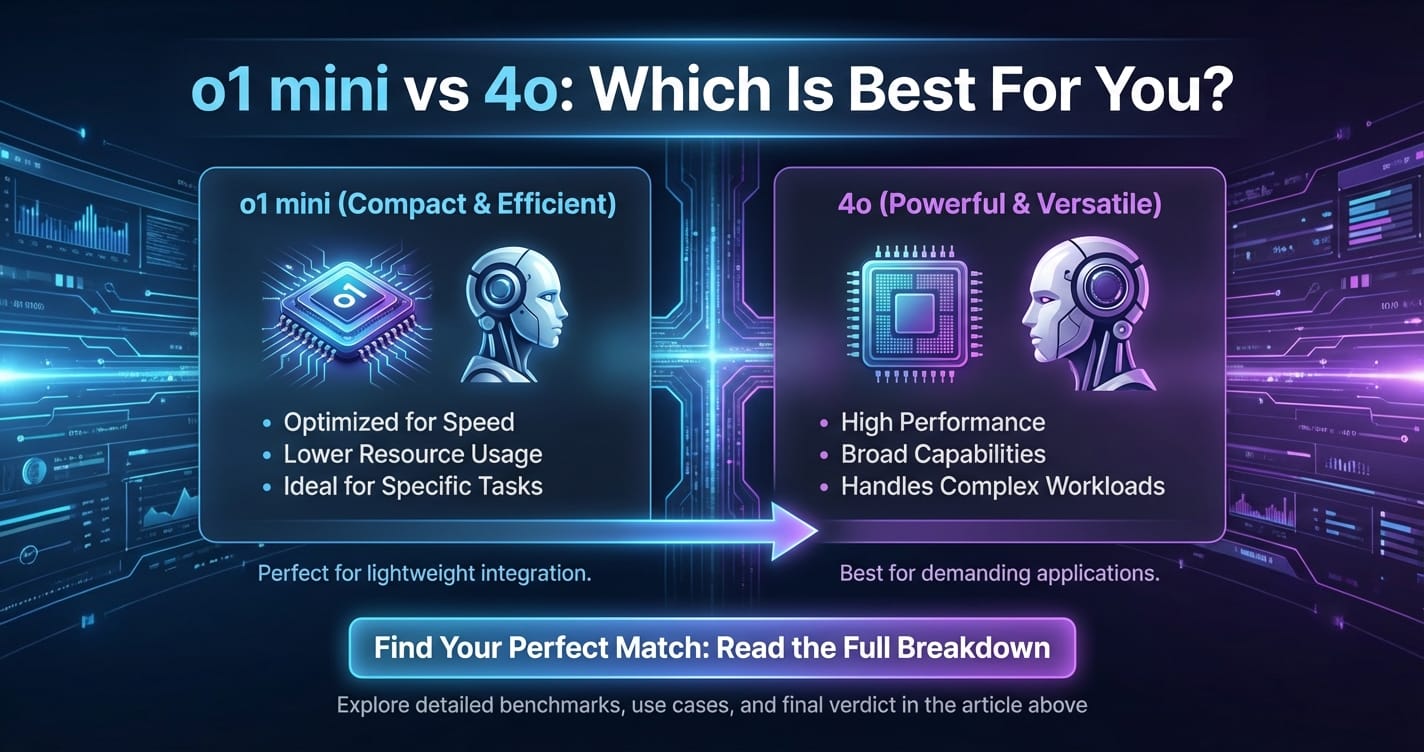
o1 mini vs 4o: Which Is Best For You?

The artificial intelligence landscape is evolving at an unprecedented pace, marked by breakthroughs that continually redefine what’s possible. From sophisticated language models capable of drafting intricate prose to multimodal systems that can understand and generate content across text, audio, and visual domains, AI is becoming increasingly integrated into our daily lives and technological infrastructure. This rapid advancement presents both immense opportunities and complex choices, particularly for developers, businesses, and enthusiasts looking to leverage these powerful tools. In this dynamic environment, two distinct philosophies of AI model development are gaining prominence: the pursuit of highly generalized, incredibly capable large models, and the focus on ultra-efficient, specialized small models designed for specific tasks and environments.
This article delves into a detailed comparison between two prominent, albeit conceptually distinct, representatives of these philosophies: OpenAI's GPT-4o (often referred to simply as "4o"), a multimodal behemoth known for its versatility and performance, and "o1 mini," a term we'll use to represent the emerging class of compact, highly optimized AI models built for efficiency, speed, and potentially on-device deployment. The choice between a powerful generalist like GPT-4o and a specialized, agile model like the conceptual "o1 mini" is not trivial; it depends entirely on your specific needs, constraints, and strategic objectives.
Our objective is to provide a comprehensive analysis that goes beyond surface-level comparisons. We will explore the architectural underpinnings, core capabilities, inherent strengths, and practical limitations of each approach. We’ll examine how they handle different modalities—text, audio, and vision—and dissect their performance across critical metrics such as speed, accuracy, and resource consumption. Furthermore, we will identify ideal use cases for each model type, considering factors like real-time requirements, data privacy, computational budget, and development complexity. The discussion will also touch upon the nuance of "gpt-4o mini," clarifying its position within OpenAI's offerings and how it relates to the broader pursuit of more accessible and efficient AI. By the end of this deep dive into o1 mini vs 4o, you will be equipped with the insights needed to make an informed decision on which AI paradigm, or combination thereof, is best suited for your projects and strategic vision. This exploration of o1 mini vs gpt 4o aims to clarify the often-confusing array of choices, guiding you toward optimal AI integration.
1. Understanding the Contenders - A Deep Dive into GPT-4o
OpenAI's GPT-4o represents a significant leap forward in the realm of large language models, pushing the boundaries of multimodal interaction and efficiency. Launched with considerable fanfare, it positioned itself as a "new flagship model" capable of reasoning across audio, vision, and text in real-time. To truly appreciate its capabilities and understand its standing in the AI ecosystem, we must dissect its genesis, architectural principles, and operational characteristics.
1.1 The Genesis and Evolution of GPT-4o
GPT-4o, where "o" stands for "omni," signifies OpenAI's ambitious vision for a truly multimodal AI. It builds upon the foundational successes of its predecessors, GPT-3.5 and GPT-4, which primarily excelled in text-based understanding and generation. The evolution from these text-centric models to GPT-4o involved a concerted effort to integrate different modalities more seamlessly and efficiently. Previously, multimodal interactions with models like GPT-4 often involved chaining separate components—a speech-to-text model, then GPT-4 for processing, and finally a text-to-speech model for output. This pipeline approach, while functional, introduced latency and potential loss of nuance.
GPT-4o was engineered to overcome these limitations by processing text, audio, and visual inputs and outputs inherently within a single neural network. This "end-to-end" design is crucial; it means the model can observe and interpret multimodal signals directly, leading to a richer understanding of context and emotion, especially in audio and visual cues. For instance, it can detect nuanced tones of voice, observe facial expressions in a video, and integrate that information directly into its reasoning process, much like humans do.
A key aspect of GPT-4o's introduction was its emphasis on speed and cost-effectiveness. OpenAI marketed it as being significantly faster and 50% cheaper than GPT-4 Turbo for API usage, while matching GPT-4 Turbo’s performance on text and coding and exhibiting superior capabilities in vision and audio. This strategic positioning was critical, making advanced AI capabilities more accessible to a wider range of developers and applications. The mention of "gpt-4o mini" often arises in discussions about this cost and speed optimization. It's important to clarify that "gpt-4o mini" is not a separate, officially designated model version. Instead, GPT-4o itself is the optimized, more accessible version compared to its GPT-4 predecessor. It embodies the characteristics one might expect from a "mini" version—faster inference, lower cost—but it achieves this without sacrificing the high quality and advanced reasoning capabilities that define the GPT-4 family. In essence, GPT-4o effectively serves as a more efficient iteration, broadening the practical deployment scenarios for a powerful, general-purpose AI.
1.2 Core Architectural Principles and Capabilities
The architectural innovation behind GPT-4o lies in its truly native multimodal processing. Unlike previous models that might preprocess audio into text or vision into descriptions before feeding it to a core language model, GPT-4o's neural network is trained to understand and generate information directly across these diverse input types. This unified architecture allows for several groundbreaking capabilities:
- Real-time Multimodal Interaction: GPT-4o can respond to audio inputs in as little as 232 milliseconds, with an average of 320 milliseconds, which is comparable to human conversation speed. This low latency is vital for applications requiring natural, fluid interaction, such as voice assistants, real-time translation, or interactive tutoring systems. The ability to switch seamlessly between speaking, seeing, and typing within the same interaction flow transforms user experience.
- Enhanced Emotional Understanding and Expression: By processing audio directly, GPT-4o can interpret intonation, pitch, and rhythm, allowing it to pick up on emotional cues in speech. Conversely, when generating audio responses, it can modulate its tone and delivery to convey appropriate emotions, making interactions far more natural and engaging. Similarly, its vision capabilities enable it to understand emotional expressions or actions in images and video.
- Sophisticated Text and Code Generation: While its multimodal features are revolutionary, GPT-4o maintains and often surpasses the text and code generation prowess of its predecessors. It can handle complex reasoning tasks, generate creative content (poetry, scripts, musical pieces), summarize dense information, translate languages with high fidelity, and assist with intricate coding challenges. Its large context window further enhances its ability to process and generate long-form, coherent content.
- Advanced Vision Capabilities: GPT-4o can interpret complex visual information, from describing intricate scenes in photographs to analyzing charts and graphs, understanding handwritten notes, and even identifying objects in real-time video streams. This opens doors for applications in accessibility, content moderation, data visualization interpretation, and augmented reality.
1.3 Key Strengths of GPT-4o
GPT-4o’s unique combination of features translates into several compelling strengths:
- Unrivaled Versatility and Generality: This is perhaps its greatest asset. GPT-4o is not specialized for one task; it excels across a vast spectrum of text, audio, and vision-related challenges. Whether you need a chatbot, a content generator, a code assistant, an image describer, or a real-time voice interface, GPT-4o offers a powerful solution, often requiring minimal fine-tuning.
- High-Quality Output Across Modalities: The quality of its generated text is top-tier, comparable to or exceeding human-level performance in many benchmarks. Its audio generation is remarkably natural, and its vision understanding is robust, leading to accurate and insightful interpretations. This consistent high quality makes it reliable for critical applications.
- Developer-Friendly API Access: OpenAI's commitment to democratizing AI is evident in its well-documented and accessible API. Developers can easily integrate GPT-4o into their applications, leveraging existing libraries and tools. This ease of integration significantly lowers the barrier to entry for building sophisticated AI-powered products.
- Robustness and Large Context Window: GPT-4o can handle long and complex prompts and conversations, maintaining context over extended interactions. This is crucial for applications that require deep engagement or analysis of large bodies of information, allowing for more coherent and sophisticated outputs.
- Continuous Improvement and Ecosystem Support: Being at the forefront of AI research, GPT-4o benefits from continuous updates, performance enhancements, and a vibrant ecosystem of tools, tutorials, and community support, ensuring its capabilities evolve with new discoveries.
1.4 Potential Limitations and Considerations
Despite its impressive strengths, GPT-4o is not without its limitations, especially when considering very specific application needs:
- Computational Demands (Cloud-Based): While more efficient than its predecessors, GPT-4o still operates as a large, cloud-based model. This means that every interaction requires sending data to OpenAI's servers for processing. For applications requiring strict data locality, offline functionality, or ultra-low latency that cannot tolerate network round trips, this architecture can be a bottleneck.
- Cost Implications for Very High-Volume Use: Although GPT-4o is cheaper per token/interaction than GPT-4 Turbo, the cumulative cost for extremely high-volume, continuous usage across millions of users or constant real-time streaming data can still be substantial. Businesses must carefully model their operational expenses, particularly if they are building applications where every millisecond and every token counts towards a budget.
- Latency for Ultra-Low-Latency Edge Applications: While its average response time of 320ms for audio is impressive, for certain niche applications like real-time control systems, surgical assistance, or augmented reality overlays where sub-100ms or even sub-50ms responses are critical, cloud-based models, even highly optimized ones, may introduce too much latency due to network travel time.
- Dependency on Internet Connectivity: As a cloud-hosted service, GPT-4o requires a stable internet connection to function. This makes it unsuitable for environments with intermittent or no connectivity, such as remote locations, certain industrial settings, or mobile applications designed for offline use.
- General Purpose vs. Extreme Specialization: While GPT-4o is incredibly versatile, its generalist nature means it might not always achieve the absolute highest possible accuracy or efficiency for highly specialized, narrow tasks when compared to a model explicitly designed and meticulously fine-tuned for that single, specific purpose. For instance, a medical imaging model trained on millions of specific scans might outperform GPT-4o in diagnostic precision for that one task.
In summary, GPT-4o stands as a monumental achievement in general-purpose, multimodal AI. It empowers developers with an accessible, high-performance tool capable of handling a vast array of complex tasks. However, its cloud-native architecture and generalist design naturally lead us to consider scenarios where a different approach—one prioritizing extreme efficiency and specialized on-device operation—might offer a more optimal solution. This brings us to the conceptual realm of "o1 mini."
2. Deciphering "o1 mini" - The Vision of Ultra-Efficient AI
While GPT-4o dominates the conversation around general-purpose, cloud-based AI, there's a parallel, equally vital evolution happening in the world of compact, highly efficient models. The term "o1 mini" is not tied to a specific, publicly released product in the same way GPT-4o is, but rather serves as a representative concept. It embodies the characteristics and aspirations of a new generation of small multimodal models meticulously engineered for minimal resource consumption, ultra-low latency, and often, on-device (edge) deployment. Think of it as the ultimate expression of AI designed for constrained environments and highly specialized, real-time interactions.
2.1 The Concept of "o1 mini": A New Frontier in Compact AI
The notion of "o1 mini" arises from the growing demand for AI that can operate with extraordinary efficiency, often directly on hardware without relying on cloud infrastructure. This isn't just about making models smaller; it's about fundamentally redesigning them to achieve specific performance targets in environments where every byte of memory, every watt of power, and every millisecond of latency is critical. This approach is heavily influenced by advancements in areas like TinyML, edge AI, and the pursuit of truly intelligent, responsive physical devices.
The design philosophy behind "o1 mini" would prioritize:
- Minimal Resource Footprint: Models that can run effectively on low-power processors (e.g., microcontrollers, embedded systems, mobile chips) with limited RAM and computational cycles.
- Edge Deployment: The ability to perform inference directly on the device where data is generated, eliminating the need to send data to the cloud. This has profound implications for privacy, security, and responsiveness.
- Real-time Processing: Achieving extremely fast inference times, often measured in tens of milliseconds or less, which is crucial for interactive applications where any noticeable delay would degrade the user experience.
- Specialization: Unlike generalist models, "o1 mini" would likely be optimized for a narrower set of tasks or a specific domain. This specialization allows for significant architectural and algorithmic optimizations that general models cannot afford.
Inspiration for such a concept can be drawn from various ongoing research and development efforts: Google's Project Astra, which aims for models that perceive and interact with the world in real-time; Meta's focus on open-source Llama models that can be fine-tuned and deployed on consumer hardware; Apple's on-device AI capabilities; and the proliferation of dedicated AI accelerators in smartphones and IoT devices. "o1 mini" represents the culmination of these trends, a hypothetical but increasingly plausible multimodal model built from the ground up for the edge.
2.2 Architectural Innovations and Target Applications
To achieve its remarkable efficiency, an "o1 mini" model would employ a suite of advanced architectural and optimization techniques:
- Quantization: Reducing the precision of model weights (e.g., from 32-bit floating point to 8-bit integers or even lower) to decrease model size and speed up computation with minimal impact on accuracy.
- Pruning: Removing redundant or less important neurons and connections from the neural network without significantly degrading performance.
- Distillation: Training a smaller "student" model to mimic the behavior of a larger, more complex "teacher" model, effectively transferring knowledge and reducing model size.
- Efficient Architectures: Designing neural networks with fewer parameters, shallower layers, or novel, highly optimized layer types (e.g., MobileNets, EfficientNets) that achieve good performance with significantly less computation.
- Hardware Acceleration: Leveraging specialized on-device AI accelerators (NPUs, TPUs, GPUs on mobile) to perform inference with maximum speed and energy efficiency.
These innovations target a distinct set of applications where cloud-based models fall short:
- Ultra-Low Latency Conversational AI: Imagine smart speakers or wearables that respond instantly, without any perceived delay, understanding nuanced voice commands and even emotions directly on the device.
- Industrial IoT and Edge Analytics: Monitoring machinery, detecting anomalies, or performing predictive maintenance in real-time, directly at the source of data generation, without sending sensitive or voluminous data to the cloud.
- Augmented and Virtual Reality (AR/VR): Real-time object recognition, spatial understanding, and context-aware interactions within immersive environments, requiring instant processing of visual and sensory data.
- Personalized On-Device Assistants: AI agents on smartphones or other personal devices that learn user habits and preferences directly on the device, offering highly personalized experiences while preserving privacy.
- Robotics and Autonomous Systems: Enabling robots to perceive, understand, and react to their environment instantaneously, without reliance on network connectivity, crucial for safety and reliability.
- Offline Accessibility: Providing robust AI functionality in environments with no internet access, such as remote field operations, aircraft, or developing regions.
2.3 Distinct Advantages of "o1 mini" (Hypothetical)
The design principles of "o1 mini" confer several compelling advantages that distinguish it from larger, cloud-based generalist models:
- Unparalleled Speed and Ultra-Low Latency: This is arguably the primary driver for "o1 mini." By running directly on the device, it eliminates network latency, allowing for response times that can be in the range of tens of milliseconds, making interactions feel truly instantaneous and seamless. For audio processing, achieving sub-20ms latency could enable new forms of real-time human-computer interaction.
- Enhanced Data Privacy and Security: Processing data on the device means sensitive information never leaves the user's personal hardware. This is a critical advantage for applications dealing with personal health data, financial information, or proprietary business intelligence, mitigating concerns about cloud data breaches or compliance with regulations like GDPR.
- Cost-Effectiveness for Specific, High-Volume On-Device Tasks: While training an "o1 mini" might be resource-intensive, the inference cost per interaction can be virtually zero once deployed, as it leverages the user's existing hardware. This is a massive economic advantage for applications with millions of users performing frequent, short AI interactions, avoiding recurring API call costs.
- Superior Energy Efficiency: Smaller models require less computational power, translating into lower energy consumption. This is crucial for battery-powered devices like smartphones, wearables, and IoT sensors, extending battery life and reducing the environmental footprint of AI operations.
- Robustness in Offline Environments: Independence from internet connectivity ensures that AI functionalities remain fully operational even in remote areas, during network outages, or in secure environments where external communication is restricted. This guarantees uninterrupted service and reliability.
- Tailored Performance: Because "o1 mini" would be specialized, it could achieve extremely high accuracy and efficiency for its target tasks, potentially outperforming a generalist model that has to cater to a broader range of inputs and outputs.
- Reduced Cloud Infrastructure Costs: For businesses, shifting AI inference from the cloud to the edge can significantly reduce recurring cloud computing costs, allowing resources to be reallocated to other areas or for training even more specialized models.
2.4 Inherent Challenges and Trade-offs
However, the pursuit of extreme efficiency and specialization comes with its own set of challenges and trade-offs:
- Limited Generality and Breadth of Knowledge: The primary trade-off is scope. An "o1 mini" model, by design, would have a narrower range of capabilities compared to a generalist model like GPT-4o. It might excel at understanding specific voice commands but struggle with open-ended conversations, or be adept at identifying a particular set of objects but fail to describe a complex, novel scene.
- Reduced Parameter Count Often Means Less Complex Reasoning: Smaller models inherently have fewer parameters, which typically translates to less capacity for storing vast amounts of knowledge or performing highly complex, abstract reasoning tasks. Their "understanding" might be shallower, and their ability to generate creative or nuanced outputs could be limited.
- Training Specialized Models Can Still Be Resource-Intensive: While inference is efficient, the process of training, fine-tuning, and optimizing a complex multimodal "o1 mini" model for specific hardware and tasks can still require significant computational resources, specialized datasets, and expert knowledge.
- Hardware Dependencies and Fragmentation: Optimal performance for "o1 mini" might depend on specific hardware accelerators or operating systems, leading to potential fragmentation issues. Developers might need to create different model versions optimized for various chips or platforms, increasing development and maintenance complexity.
- Model Update and Deployment Challenges: Updating and deploying new versions of an "o1 mini" model to millions of edge devices can be more challenging than updating a single cloud-based service, requiring robust over-the-air (OTA) update mechanisms.
- Limited Adaptability Post-Deployment: Once an "o1 mini" is deployed on a device, its ability to learn new tasks or adapt to entirely new domains without re-training and re-deployment is typically limited, unlike cloud models that can be continuously updated on the backend.
In essence, "o1 mini" represents a powerful conceptual solution for a specific class of problems where efficiency, speed, privacy, and offline functionality are paramount. It's not a direct competitor in every arena to GPT-4o but rather a complementary force, pushing the boundaries of AI deployment into new, constrained environments. The choice between them hinges on whether your application demands broad intelligence or razor-sharp, on-device efficiency for specific tasks.
XRoute is a cutting-edge unified API platform designed to streamline access to large language models (LLMs) for developers, businesses, and AI enthusiasts. By providing a single, OpenAI-compatible endpoint, XRoute.AI simplifies the integration of over 60 AI models from more than 20 active providers(including OpenAI, Anthropic, Mistral, Llama2, Google Gemini, and more), enabling seamless development of AI-driven applications, chatbots, and automated workflows.
3. Head-to-Head: o1 mini vs 4o - A Comprehensive Comparison
Having explored the individual characteristics of GPT-4o and the conceptual "o1 mini," it's time to place them side-by-side to highlight their fundamental differences and identify the scenarios where each truly excels. This direct comparison will clarify the trade-offs involved and provide a framework for decision-making.
3.1 Performance Metrics: Speed, Accuracy, and Resource Consumption
Performance is a multifaceted concept in AI, encompassing not just how well a model performs a task (accuracy) but also how quickly (latency) and with what resources (computational footprint, cost). Here’s how our two contenders stack up:
| Feature/Metric | GPT-4o (Cloud-based Generalist) | "o1 mini" (Edge-optimized Specialist - Hypothetical) |
|---|---|---|
| Primary Deployment | Cloud (OpenAI API) | On-device/Edge |
| Latency (Audio) | ~232-320 ms (average) for full pipeline | Potentially < 50 ms (even < 20 ms for specific tasks) |
| Latency (Text/Vision) | Typically 1-5 seconds for complex tasks (API response) | Near instantaneous (< 100 ms) for targeted on-device tasks |
| Accuracy (Generality) | High across a broad range of tasks (text, code, vision, audio) | High for its specialized domain; limited for general tasks |
| Accuracy (Specialization) | Good, but may not be optimal for hyper-specialized tasks | Potentially superior for its specific optimized task/domain |
| Computational Footprint | High (large GPU clusters in data centers) | Very Low (optimized for mobile SoCs, NPUs, microcontrollers) |
| Energy Consumption | High (per inference on cloud servers) | Very Low (per inference on device, extends battery life) |
| Cost Model | Pay-per-token/usage (API calls) | Upfront development/training cost; near-zero per-inference cost |
| Internet Dependency | Required | Optional (can function offline) |
| Model Size | Gigabytes to Terabytes (for underlying foundation model) | Megabytes to Tens of Megabytes |
Latency: This is a crucial differentiator. GPT-4o’s average audio response time of 320ms, while groundbreaking for a cloud model, still involves network round trips. For "o1 mini," the entire inference happens locally, potentially reducing latency to single or double-digit milliseconds, making interactions feel truly immediate—a critical factor for direct brain-computer interfaces, advanced robotics, or safety-critical systems. For general text and vision, GPT-4o's API responses can vary, whereas a dedicated "o1 mini" processing a localized visual stream could offer near-instant understanding.
Accuracy: GPT-4o’s strength lies in its general accuracy across a vast array of tasks. It's a polymath. "o1 mini," by contrast, would be a specialist. Its accuracy would be exceptionally high within its specific domain (e.g., recognizing 100 specific voice commands with 99.9% accuracy in noisy environments) but would likely fall short on general knowledge or complex reasoning outside its training scope.
Resource Consumption: GPT-4o demands the immense power of cloud data centers. An "o1 mini" would be designed to run on the much more constrained resources of an edge device, consuming minimal power and memory. This has significant implications for both operational costs and environmental impact.
3.2 Modality Handling and Multimodal Integration
Both models are multimodal, but their approach and implications differ:
- GPT-4o: Features truly end-to-end multimodal processing within a single neural network. It understands the interplay between text, audio, and vision intrinsically. This means it can grasp subtleties like sarcasm in voice alongside textual content, or interpret charts within an image while discussing their implications. Its strength lies in synthesizing information across all modalities for a holistic understanding.
- "o1 mini": Would also be multimodal, but likely optimized for specific multimodal interactions relevant to its use case. For example, a voice assistant "o1 mini" might excel at real-time speech-to-intent and personalized voice generation. A vision-focused "o1 mini" might be highly optimized for rapid object detection and tracking in a video stream. While it processes multiple modalities, its integration might be more streamlined or focused on a particular "fusion" point, rather than the broad, flexible integration of GPT-4o. The key difference is the breadth vs. depth of multimodal understanding—GPT-4o for general, nuanced understanding, "o1 mini" for rapid, specialized interpretation.
3.3 Use Cases and Ideal Environments
The diverging strengths of each model type dictate their optimal deployment scenarios:
When to Choose GPT-4o:
- Complex Content Creation and Ideation: From drafting marketing copy and academic papers to generating creative stories, code, or even musical compositions, GPT-4o's general intelligence and creative capacity are unmatched.
- General-Purpose Chatbots and Virtual Assistants: For customer support, interactive information retrieval, or virtual companions that need to handle a wide variety of topics and provide nuanced responses across text, voice, and vision.
- Sophisticated Data Analysis and Interpretation: Analyzing complex datasets, interpreting charts, summarizing research papers, or extracting insights from unstructured text.
- Software Development and Code Generation: Assisting developers with coding, debugging, generating documentation, and understanding complex codebases.
- Research and Exploration: Rapid prototyping of AI ideas, exploring new applications, or augmenting human intelligence across diverse knowledge domains.
- Applications Requiring Broad World Knowledge: If your AI needs to answer questions on virtually any topic, understand diverse contexts, and perform open-ended reasoning.
When to Consider "o1 mini" (or its conceptual equivalent):
- Ultra-Low Latency Conversational Interfaces: For voice assistants in smart homes, cars, or wearables where any delay is unacceptable. Think of systems that need to respond in milliseconds to voice commands or emotional cues.
- Real-time Edge AI for IoT and Industrial Applications: Monitoring sensor data, performing anomaly detection on a factory floor, or controlling robotic arms with immediate feedback, without relying on cloud connectivity.
- Privacy-Sensitive On-Device Processing: Healthcare applications, personal financial assistants, or any system where sensitive user data should never leave the device.
- Augmented Reality (AR) and Virtual Reality (VR): Instantaneous object recognition, gesture interpretation, and scene understanding that needs to happen directly on AR/VR headsets to maintain immersion and responsiveness.
- Offline Functionality: Applications designed for environments with unreliable or no internet access, such as remote field work, travel, or secure government/military operations.
- Resource-Constrained Devices: Deploying AI on microcontrollers, embedded systems, or older mobile devices where power and memory are severely limited.
- Cost-Optimized High-Volume On-Device Interactions: For consumer products with millions of users performing frequent, short AI tasks, where per-inference cloud costs would quickly become prohibitive.
3.4 Development and Deployment Considerations
The choice between "o1 mini" and GPT-4o also impacts the development and deployment lifecycle:
- API Accessibility and Ease of Integration: GPT-4o excels here with its well-documented API, extensive SDKs, and a large developer community. Integration is often as simple as making an HTTP request. For "o1 mini," direct API access might not exist; instead, it would likely be integrated as a library or an inference engine run on device. This can involve more complex engineering to deploy and manage.
- On-device vs. Cloud Deployment: GPT-4o is a cloud service, meaning deployment is handled entirely by OpenAI. For "o1 mini," developers are responsible for the entire on-device deployment pipeline, including model conversion, optimization for specific hardware, firmware updates, and ensuring compatibility across diverse devices. This requires deep expertise in embedded systems and edge AI.
- Scalability and Maintenance: Scaling GPT-4o usage involves simply increasing API calls and managing costs. OpenAI handles the underlying infrastructure. Scaling "o1 mini" means ensuring that the model runs efficiently on every target device, managing updates to potentially millions of devices, and troubleshooting device-specific issues. Maintenance also shifts from cloud infrastructure to device firmware and software.
- Cost Models: GPT-4o is a transactional cost model; you pay for what you use. This offers flexibility but can lead to unpredictable expenses for high-volume applications. "o1 mini" involves a significant upfront investment in R&D, training, and optimization, but once deployed, the per-inference cost is negligible. This model is often preferred for consumer products with fixed hardware.
3.5 The "GPT-4o mini" Angle Revisited
The concept of "gpt-4o mini" often emerges from the desire for the power of GPT-4, but with better efficiency. As discussed, GPT-4o itself is OpenAI’s answer to this. It's faster, cheaper, and more multimodal than GPT-4 or GPT-4 Turbo, thus fulfilling many of the practical needs for a "miniaturized" version within the cloud-based paradigm. It significantly reduces the barrier to entry for many applications that found previous GPT-4 versions too slow or expensive.
However, GPT-4o, for all its optimizations, remains a cloud-hosted model. It doesn't fundamentally change the need for internet connectivity, nor does it achieve the ultra-low latency or privacy guarantees of a truly on-device solution. This is where the conceptual "o1 mini" carves out its distinct territory. While GPT-4o addresses the "mini" need for cloud applications, "o1 mini" targets the "mini" need for edge applications. They serve different strategic niches.
In summary, the comparison between "o1 mini vs 4o" is not about one being definitively "better" than the other. It's about a fundamental divergence in design philosophy and target environments. GPT-4o offers unparalleled general intelligence and versatility in the cloud, while "o1 mini" (representing the class of highly optimized small models) promises extreme efficiency, speed, and privacy at the edge. The right choice hinges on a precise understanding of your application's core requirements.
4. Strategic Implications and Future Outlook
The simultaneous advancement of powerful cloud-based models like GPT-4o and the emergence of highly efficient edge-optimized models like the conceptual "o1 mini" are reshaping the strategic landscape of AI. This duality signifies a maturing industry where developers and businesses now have an unprecedented range of options, each with its own set of advantages and challenges. Navigating this complexity, and indeed leveraging it effectively, requires a nuanced understanding of hybrid architectures, economic considerations, and the critical role of platforms that can orchestrate access to diverse AI capabilities.
4.1 The Convergence of Cloud and Edge AI
The future of AI is unlikely to be solely cloud-centric or purely edge-based; instead, it will increasingly feature a sophisticated convergence of both. Hybrid architectures are becoming the norm, where specific tasks are intelligently offloaded to the most appropriate AI model, whether it resides in a data center or directly on a user’s device.
- Hybrid Architectures: Imagine a smart home assistant. An "o1 mini" might handle local, privacy-sensitive commands (e.g., "turn on lights," "set timer") with ultra-low latency and offline capability. For more complex, open-ended questions (e.g., "Explain quantum physics," "What's the latest news on climate change?"), the request could seamlessly be routed to a powerful cloud model like GPT-4o. This "intelligent routing" maximizes efficiency, privacy, and capability.
- Federated Learning: This technique allows models to be trained on data distributed across many edge devices, without the data ever leaving the device. Only model updates (gradients) are sent back to a central server, ensuring privacy while leveraging vast amounts of real-world data to improve the "o1 mini" type models.
- The Role of Orchestration: As the number of specialized and general-purpose models proliferates, choosing the right model for the right task becomes a significant challenge. Developers face a fragmented ecosystem, with different APIs, data formats, pricing structures, and performance characteristics for each model. This is precisely where unified API platforms become indispensable.
This is where XRoute.AI steps in as a cutting-edge unified API platform designed to streamline access to large language models (LLMs) for developers, businesses, and AI enthusiasts. By providing a single, OpenAI-compatible endpoint, XRoute.AI simplifies the integration of over 60 AI models from more than 20 active providers, enabling seamless development of AI-driven applications, chatbots, and automated workflows. In a world balancing between the general intelligence of a GPT-4o and the specialized efficiency of an "o1 mini" (or similar edge models when they become API-accessible), XRoute.AI offers the flexibility to dynamically select the best model for any given task.
With its focus on low latency AI and cost-effective AI, XRoute.AI empowers users to build intelligent solutions without the complexity of managing multiple API connections. For instance, a developer building a multimodal application could use XRoute.AI to intelligently route complex multimodal queries to GPT-4o, while potentially leveraging other specialized, smaller models (as they become available through unified APIs) for more specific, high-throughput tasks, all through a single, consistent interface. The platform’s high throughput, scalability, and flexible pricing model make it an ideal choice for projects of all sizes, from startups navigating complex AI choices to enterprise-level applications seeking to optimize their model usage and costs. It democratizes access to diverse AI capabilities, allowing developers to focus on innovation rather than infrastructure.
4.2 Economic and Ethical Considerations
The choice between cloud and edge, and thus between models like GPT-4o and the "o1 mini" concept, has significant economic and ethical implications:
- Cost Optimization: For businesses, understanding the total cost of ownership is paramount. While GPT-4o has a pay-per-use model, an "o1 mini" involves higher upfront R&D but potentially negligible inference costs. Strategic resource allocation, possibly using a platform like XRoute.AI to optimize model routing for cost, becomes essential. For instance, routing simpler, high-volume requests to cheaper, smaller models available through XRoute.AI, while reserving GPT-4o for complex, high-value tasks, can dramatically reduce overall expenses.
- Data Privacy and Security: The ability of "o1 mini" to process data on-device offers inherent privacy advantages, crucial in sectors like healthcare, finance, or government. Cloud-based models, while highly secure, always involve data transmission, which carries different privacy and compliance considerations.
- Environmental Impact of AI Inference: Smaller, more energy-efficient models like "o1 mini" can significantly reduce the carbon footprint of AI, especially at scale. Deploying AI closer to the data source can also reduce the energy consumed in data transmission. While GPT-4o is optimized, the sheer scale of its operations contributes to a larger overall energy demand.
- Bias and Fairness: Both model types require careful consideration of training data to mitigate bias. However, specialized "o1 mini" models, by virtue of their narrower focus, might be easier to audit and control for specific biases within their domain, whereas generalist models like GPT-4o present a more complex challenge due to their vast training data and broad capabilities.
4.3 The Shifting Landscape of AI Development
The juxtaposition of models like GPT-4o and the "o1 mini" concept signals several profound shifts in AI development:
- Increased Focus on Efficiency and Specialization: The era of simply building bigger models is giving way to a more sophisticated approach where model size and capability are carefully balanced against efficiency, cost, and specific application needs. Specialization is gaining importance for practical, real-world deployments.
- Democratization of AI via Accessible Models and Platforms: OpenAI's commitment to making GPT-4o more affordable and faster, coupled with the rise of open-source models and unified platforms like XRoute.AI, is significantly lowering the barrier to entry for AI development. More developers can now access and experiment with advanced AI, fostering innovation across industries.
- The Importance of Developer-Friendly Tools: As the AI ecosystem diversifies, tools that abstract away complexity and provide consistent interfaces become critical. Platforms that allow developers to integrate and swap between different models easily, manage API keys, monitor usage, and optimize performance are no longer a luxury but a necessity for leveraging the full potential of this diverse AI landscape. This also ensures that organizations can remain agile, experimenting with new models and providers as they emerge without extensive re-engineering.
- A New Skillset for AI Engineers: Future AI engineers will need skills not just in model training but also in model optimization for edge devices, managing hybrid cloud-edge deployments, understanding API orchestration, and making strategic choices about model selection based on a wide array of technical, economic, and ethical factors.
The future is not about choosing one model, but about intelligently integrating the strengths of many. The power of a generalist like GPT-4o, combined with the precision and efficiency of specialized "o1 mini" type models, orchestrated by platforms that simplify access and management, promises an era of highly capable, context-aware, and seamlessly integrated AI solutions.
Conclusion: Making Your Informed Choice
The journey through the intricate comparison of GPT-4o and the conceptual "o1 mini" reveals a fundamental truth about modern AI: there is no universal "best" solution. Instead, the optimal choice is a carefully considered decision, meticulously tailored to the unique demands of your specific application, the constraints of your operating environment, and your overarching strategic priorities. Both models, or rather, both paradigms of AI development, represent monumental achievements, each pushing the boundaries of what's possible in their respective domains.
GPT-4o stands as a testament to the power of general-purpose, multimodal intelligence. Its strengths lie in its unparalleled versatility, its ability to understand and generate high-quality content across text, audio, and vision, and its capacity for complex reasoning. It thrives in scenarios requiring broad knowledge, creative problem-solving, and sophisticated interaction, all accessible through a robust and developer-friendly cloud API. For applications where rich content generation, nuanced understanding, or flexible, open-ended dialogues are paramount, and where cloud dependence and moderate latency are acceptable, GPT-4o is an exceptionally powerful tool. It has democratized access to what was once considered bleeding-edge AI, making it a go-to for a vast array of online applications.
Conversely, the conceptual "o1 mini" embodies the frontier of ultra-efficient, specialized AI. It represents the relentless pursuit of speed, privacy, and operational independence at the edge. Its hypothetical advantages — sub-50ms latency, on-device processing, minimal power consumption, and offline functionality — make it indispensable for applications where every millisecond counts, where data privacy is non-negotiable, or where network connectivity is unreliable. For real-time physical interactions, embedded intelligence, and situations demanding absolute immediacy and local processing, the "o1 mini" paradigm offers a uniquely compelling solution, albeit often with a narrower scope of capabilities.
To summarize the decision framework:
| Scenario / Priority | Choose GPT-4o | Choose "o1 mini" (Conceptual) |
|---|---|---|
| Primary Goal | General intelligence, creative output, broad capability | Ultra-low latency, efficiency, privacy, offline functionality |
| Application Type | Sophisticated chatbots, content platforms, dev tools, research | Real-time voice assistants, AR/VR, IoT, robotics, offline apps |
| Data Privacy | Cloud-based (requires trust in provider & data governance) | On-device (data remains local, maximum privacy) |
| Latency Tolerance | Moderate (hundreds of ms to seconds) | Extremely low (tens of ms or less) |
| Connectivity Need | Always requires internet access | Can function entirely offline |
| Cost Model | Pay-as-you-go (API calls), predictable for specific usage | High upfront R&D, low/zero per-inference cost on device |
| Development Effort | Easier API integration, less infra management | More complex edge deployment, hardware optimization |
| Scope of Knowledge | Broad, general world knowledge | Narrow, specialized knowledge for specific tasks |
The exciting reality is that you don't always have to choose one over the other. The future of AI is increasingly hybrid, where cloud and edge models work in concert. Imagine a system where "o1 mini" handles the immediate, localized responses, while seamlessly offloading more complex or open-ended queries to the robust capabilities of GPT-4o in the cloud. Such intelligent orchestration requires sophisticated tooling, and platforms like XRoute.AI are emerging as critical enablers. By offering a unified API platform to access a multitude of LLMs with features like low latency AI and cost-effective AI, XRoute.AI empowers developers to fluidly integrate and manage these diverse models, allowing them to build intelligent, responsive, and highly optimized applications that leverage the best of both worlds.
Ultimately, your decision should be a strategic one, born from a clear understanding of your project’s core requirements and constraints. Both GPT-4o and the conceptual "o1 mini" represent powerful forces in the AI revolution. By carefully considering their strengths and limitations, you can make an informed choice that propels your innovations forward, unlocking new possibilities in an ever-evolving technological landscape.
Frequently Asked Questions (FAQ)
Q1: Is "o1 mini" a real product I can use today?
A1: "o1 mini" is used in this article as a conceptual term to represent the emerging category of ultra-efficient, highly specialized, and often on-device (edge) AI models. While there isn't a specific product named "o1 mini" that you can access, the characteristics and advantages described are indicative of ongoing research and development in compact AI, like those seen in TinyML or specialized models for mobile and IoT devices.
Q2: How does GPT-4o compare to previous GPT-4 versions in terms of cost and speed?
A2: GPT-4o is significantly more cost-effective and faster than its predecessors, GPT-4 and GPT-4 Turbo. OpenAI states it is 50% cheaper for API usage than GPT-4 Turbo and offers much faster response times, especially for audio interactions, making advanced AI capabilities more accessible and practical for a wider range of applications. It essentially serves as an optimized, more efficient iteration within the GPT-4 family.
Q3: Can I combine the strengths of both types of models (e.g., GPT-4o and a conceptual "o1 mini")?
A3: Absolutely. This hybrid approach is increasingly seen as the future of AI. You can design architectures where a lightweight, on-device model (like "o1 mini") handles simple, real-time, privacy-sensitive tasks locally, while more complex or general queries are intelligently routed to a powerful cloud model like GPT-4o. This allows applications to achieve both extreme efficiency and broad intelligence.
Q4: What are the main benefits of using a unified API platform like XRoute.AI?
A4: XRoute.AI offers several key benefits: it simplifies access to over 60 different LLMs from multiple providers through a single, OpenAI-compatible API endpoint, reducing development complexity. It focuses on low latency AI and cost-effective AI, allowing developers to dynamically choose the best model for a task based on performance or price. This unified approach provides flexibility, scalability, and streamlines the integration of diverse AI capabilities into applications, enabling developers to focus on innovation rather than managing multiple API connections.
Q5: Which model is better for real-time conversational AI?
A5: For cloud-based, general-purpose real-time conversational AI (e.g., sophisticated chatbots, virtual assistants needing broad knowledge), GPT-4o is an excellent choice due to its multimodal understanding and impressive response speed for a cloud model. However, for ultra-low latency, on-device real-time conversational AI where network delays are unacceptable, privacy is paramount, or offline functionality is required (e.g., smart speakers, wearables with sub-100ms response needs), a highly optimized, specialized model akin to the "o1 mini" concept would be superior.
🚀You can securely and efficiently connect to thousands of data sources with XRoute in just two steps:
Step 1: Create Your API Key
To start using XRoute.AI, the first step is to create an account and generate your XRoute API KEY. This key unlocks access to the platform’s unified API interface, allowing you to connect to a vast ecosystem of large language models with minimal setup.
Here’s how to do it: 1. Visit https://xroute.ai/ and sign up for a free account. 2. Upon registration, explore the platform. 3. Navigate to the user dashboard and generate your XRoute API KEY.
This process takes less than a minute, and your API key will serve as the gateway to XRoute.AI’s robust developer tools, enabling seamless integration with LLM APIs for your projects.
Step 2: Select a Model and Make API Calls
Once you have your XRoute API KEY, you can select from over 60 large language models available on XRoute.AI and start making API calls. The platform’s OpenAI-compatible endpoint ensures that you can easily integrate models into your applications using just a few lines of code.
Here’s a sample configuration to call an LLM:
curl --location 'https://api.xroute.ai/openai/v1/chat/completions' \
--header 'Authorization: Bearer $apikey' \
--header 'Content-Type: application/json' \
--data '{
    "model": "gpt-5",
    "messages": [
        {
            "content": "Your text prompt here",
            "role": "user"
        }
    ]
}'
With this setup, your application can instantly connect to XRoute.AI’s unified API platform, leveraging low latency AI and high throughput (handling 891.82K tokens per month globally). XRoute.AI manages provider routing, load balancing, and failover, ensuring reliable performance for real-time applications like chatbots, data analysis tools, or automated workflows. You can also purchase additional API credits to scale your usage as needed, making it a cost-effective AI solution for projects of all sizes.
Note: Explore the documentation on https://xroute.ai/ for model-specific details, SDKs, and open-source examples to accelerate your development.